


Next: Single Company Insuring Multiple
Up: Single Company Insuring Single
Previous: Single Company Insuring Single
First we fix the initial values, the "Contract-Vector"
 . The transformed values, the
"Fraud-Vector"
. The transformed values, the
"Fraud-Vector"  , are obtained by
maximizing the utilities
, are obtained by
maximizing the utilities  and
and  respectively. The maximization is
performed under the assumption that a partner
honors the contract
respectively. The maximization is
performed under the assumption that a partner
honors the contract 
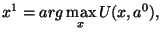 |
|
|
(21) |
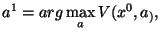 |
|
|
(22) |
Formally, condition (22) transforms the vector
 into the vector
  . To make expressions
shorter denote this transformation by
. To make expressions
shorter denote this transformation by 
 |
|
|
(23) |
One may obtain the equilibrium at the fixed point  , where
 |
|
|
(24) |
The fixed point exists, if the feasible set  is convex
and all the profit functions are convex
[2]. We obtain the equilibrium directly by
iterations (23), if the transformation is contracting
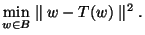
[4]. If not, then we minimize the square deviation
is convex
and all the profit functions are convex
[2]. We obtain the equilibrium directly by
iterations (23), if the transformation is contracting
[4]. If not, then we minimize the square deviation
 |
|
|
(25) |
The equilibrium is achieved, if the minimum (25)
is zero. If the minimum (25) is positive then the equilibrium does not exist. That is a theoretical conclusion.
In statistical modeling, some deviations are inevitable. Therefore,
we assume that the equilibrium exists, if the minimum is
not greater then modeling errors.
Next: Single Company Insuring Multiple
Up: Single Company Insuring Single
Previous: Single Company Insuring Single
2002-11-04