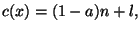
In this section the insurance model of multiple objects  is reduced to
that of a single object.
Some companies apply "zero-one" insurance policies:
is reduced to
that of a single object.
Some companies apply "zero-one" insurance policies:  or
or  .
In this case no equilibrium exist because only
two discrete strategies can be applied2.
If a number of customers is large,
for example a set of car owners, one approximates discrete set
by the continuous one assuming that
.
In this case no equilibrium exist because only
two discrete strategies can be applied2.
If a number of customers is large,
for example a set of car owners, one approximates discrete set
by the continuous one assuming that  is a sum of
insurance policies of
is a sum of
insurance policies of
 customers that decided to
insure their property
customers that decided to
insure their property
 .
Here
.
Here  is a number of customers that decided to insure
their objects including
is a number of customers that decided to insure
their objects including  insured survivors.
Then
insured survivors.
Then  is a number of not insured objects including
 of not insured survivors.
Assume as a first approximation that
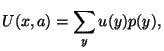
 some cumulative utility function for a set of customers
where variable
some cumulative utility function for a set of customers
where variable  means their total wealth.
In theory the cumulative utility is determined by individual
utilities
means their total wealth.
In theory the cumulative utility is determined by individual
utilities  . However, that is not a trivial computational problem.
Statistical analysis of corresponding data is needed, too.
. However, that is not a trivial computational problem.
Statistical analysis of corresponding data is needed, too.
Under these assumptions the expected cumulative utility
 is a probability of the wealth .
Suppose that total wealth of all customers
 .
.
From (26)
 is a number customers that decided to
insure their property and is a number of not insured survivors.
is a number customers that decided to
insure their property and is a number of not insured survivors.
From the assumption that survival probabilities  of all the objects3 are
equal and independent follows the binomial distribution.
If
of all the objects3 are
equal and independent follows the binomial distribution.
If  , where
  , is
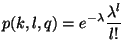
not very large and not very small then one approximates the binomial distribution by the Poisson
distribution . The probability that of
, is
not very large and not very small then one approximates the binomial distribution by the Poisson
distribution . The probability that of  objects survive and the rest
  do not
 |
(29) |
of returned wealth 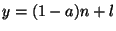 is
is
 |
(30) |
 .
.
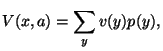
The expected utility  of insurance company
is defined in a similar way.
of insurance company
is defined in a similar way.
is a probability of profit ,
 is an utility function of the profit .
Suppose that
 .
.
From (26)
is a number customers that decided to
insure their property and is a number of insured survives.
From here and assumption (26)
the probability of profit

 |
(33) |
for an insurance company.
Here insurance policy is defined indirectly
by the number of customers that insure their of objects
maximizing their expected cumulative utility
(15) that depends on the rate of insurance charge  .
This is a correct assumption if the cumulative utility function
represents individual utilities well enough.
Therefore definition of is important part of model
that represents multiple customers as a single one.
.
This is a correct assumption if the cumulative utility function
represents individual utilities well enough.
Therefore definition of is important part of model
that represents multiple customers as a single one.
The equilibrium between interests of the company and the customer
is achieved when both insurance policy and
insurance charge satisfies Nash conditions.
One obtains the Nash equilibrium using the same expressions as in
the previous section.