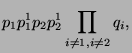
are defined by contracts.
Only the reliabilities
are defined by contracts.
Only the reliabilities
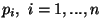 of banks are uncertain.
Investing in stocks, in addition to reliabilities
of banks are uncertain.
Investing in stocks, in addition to reliabilities
 of companies, their future stock rates are uncertain, too. The predicted stock rates are defined by a coefficient
  that shows the relation between the present and the predicted stock rates. The prediction "horizon" is supposed to be the same as the maturity time of CD.
To simplify the model suppose that one predicts  different values of relative stock rates
 with corresponding estimated probabilities
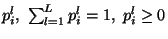 .
.
In this case,
one may define probabilities  of discrete values of
wealth
of discrete values of
wealth
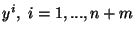 by exact expressions.
The expressions for CD remains the same. Therefore,
we shall consider only stocks assuming that
by exact expressions.
The expressions for CD remains the same. Therefore,
we shall consider only stocks assuming that  and
and  .
Then
.
Then
 .
The reliabilities
.
The reliabilities  , the stock rate predictions
  and their estimated probabilities
  are defined by
experts, possibly, with the help of time series models such as ARMA
For example, maximal values of multi-step prediction
are considered as "optimistic" estimates. The minimal values- as "pessimistic" ones. The average values of multi-step prediction are regarded as "realistic" estimates.
are defined by
experts, possibly, with the help of time series models such as ARMA
For example, maximal values of multi-step prediction
are considered as "optimistic" estimates. The minimal values- as "pessimistic" ones. The average values of multi-step prediction are regarded as "realistic" estimates.
Here is a simplest illustration were  and . In this case from (5) (10)
the probabilities
and . In this case from (5) (10)
the probabilities  of wealth returns
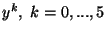 are
are
 .
.