next up previous
Next: Investment in CD and Up: Expected Utility Previous: Expected Utility

Investment in CD

One may define probabilities $p(y^j)$ of discrete values of wealth $y^j,\ j=1,2,....$ by exact expressions. For example,
$\displaystyle p(y^0)$ $\textstyle =$ $\displaystyle \prod_{i} q_i,$  
$\displaystyle p(y^1)$ $\textstyle =$ $\displaystyle p_1 \prod_{i \ne 1} q_i,$  
$\displaystyle p(y^2)$ $\textstyle =$ $\displaystyle p_2
\prod_{i \ne 2} q_i,$  
$\displaystyle .............$   $\displaystyle ...................................$  
$\displaystyle p(y^n)$ $\textstyle =$ $\displaystyle p_n
\prod_{i \ne n} q_i ,$  
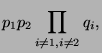
$\displaystyle p(y^{n+1})$ $\textstyle =$ $\displaystyle p_1 p_2 \prod_{i
\ne 1, i \ne 2} q_i ,$  
$\displaystyle p(y^{n+2})$ $\textstyle =$ $\displaystyle p_1 p_3 \prod_{i
\ne 1, i \ne 3} q_i$ (5)
$\displaystyle .............$   $\displaystyle ..................................................$  

Here
$y^0=0,\ y^1=a_1 x_1,\ y^2=a_2 x_2,\ y^n= a_n x_n,\\ y^{n+1}=a_1 x_1+a_2 x_2,\ y^{n+2}=a_1 x_1 + a_3 x_3$. From expression (5)
$\displaystyle U(x)=\sum_{k=1}^M u(y^k) p(y^k).$     (6)

Here $M$ is the number of different values of wealth $y$.

One determines $U(x)$ approximately by the Monte Carlo approach:

$\displaystyle U_K(x)= 1/K \sum_{k=1}^K u(y^k).$     (7)

Here
$\displaystyle y^k= \sum_{i=1}^n y_i^k ,$     (8)

where
$\displaystyle y_i^k=
\left\{
\begin{array}{ll}
c_i x_i, & \mbox{if $\eta_i^k \in [0,p_i]$} \\
0, & \mbox{otherwise}
\end{array}\right.$     (9)

Here $K$ is the number of Monte Carlo samples. $\eta_i^k $ is a random number uniformly distributed on the unit interval. In this case
$\displaystyle U(x)= \lim_{K \to \infty} U_K(x).$      


next up previous
Next: Investment in CD and Up: Expected Utility Previous: Expected Utility
2002-11-04