In this section the optimal insurance is regarded as a special case
of optimal investment.
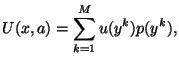
Then the expected utility at the end of the next year
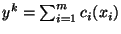
 is a probability to get a wealth
  ,
,
 is an utility function of this wealth .
 is a vector which components
 define rates of insurance charges
for different objects
define rates of insurance charges
for different objects  .
Suppose that
.
Suppose that
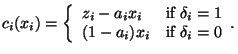
 denotes insurance charge of the object
  ,
,
 is insurance policy of the object ,
 is market value of the object ,
 , if the object survives,
 , otherwise,
 is a survival probability of the object .
 ,
,
 ,
,
 .
.