


The ARMA model optimization results are the points  and
and  (see Figure 1.1) .
These results were defined using a
sequence of two global methods
referred to as
(see Figure 1.1) .
These results were defined using a
sequence of two global methods
referred to as  and
and  (see [14]).
denotes a search in accordance with a multi-dimensional
Bayesian model [].
The best result obtained by after 50 iterations is a starting point for an one-dimensional coordinate search using 60 iterations by [].
(see [14]).
denotes a search in accordance with a multi-dimensional
Bayesian model [].
The best result obtained by after 50 iterations is a starting point for an one-dimensional coordinate search using 60 iterations by [].
The maximal number of auto-regression (AR) parameters  was
was  . Here
  if no external factors are involved. The optimal number is defined by structural stabilization (see chapter 1.10) . Plotting surfaces and contours the number of moving-average (MA) parameters was fixed
 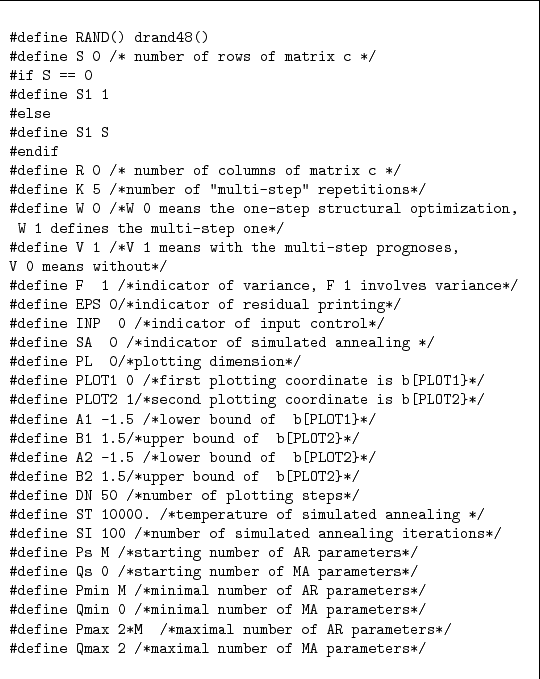 . The results in Table 1.1 were obtained by optimization of both structural variables and
  .
.
The objective of this work is mainly to show a multi-modality of
the problem. Therefore to save the computing time the global optimization was carried out
approximately using not many of iterations. The results
of global optimization
were used as a starting point for local optimization.
The reason is that the squared deviation as a function of parameters is multi-modal
considering the wide range of these parameters and becomes uni-modal regarding the narrow range (see Figures 1.16).
Thus we guarantee the final results at least as good as
that of local optimization.
The high-accuracy global optimization is very expensive.
As usual,
the computing time is an exponential function of accuracy in the global optimization.
Therefore, what happens after the high-accuracy global optimization of the objective function, is not yet clear.
However, it seems clear that the investigation of multi-modality
of squared deviation and variability of the parameters should be the first step in estimating parameters of non-linear regression models, including the ARFIMA ones![[*]](file:/usr/share/latex2html/icons/footnote.png) .
Balancing computing expenses and accuracy of estimation
is the important problem of future investigation
in both the fields of exchange rate prediction and global optimization.
.
Balancing computing expenses and accuracy of estimation
is the important problem of future investigation
in both the fields of exchange rate prediction and global optimization.