We compare the "next-day" ARMA prediction results and
a simple Random Walk (RW) model. In RW model the next day value is
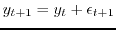 and the predicted value is equal to the conditional expectation of
  . This means that the present value is the RW prediction for the next day.
There are two reasons to consider RW models
 ,
,  , and
, and  .
.
 are independent.
 |
 |
 |
 |
$/ |
- 1.779090e-01 | 1.293609e+00 | 8.454827e-02 |
| DM/$ | - 1.191e-02 | 1.092e-01 | 9.985e-02 |
| Yen/$ | - 1.086e+00 | 6.369e+00 | 6.446505e+00 |
| Fr/$ | - 3.029e-01 | 4.285e-01 | 3.395e-01 |
| AT&T | -1.375e+00 | 4.554e+00 | 3.621e+00 |
| Intel Co | +2.814e-01 | 2.052e+01 | 1.936e+00 |
| Hermis Bank | -4.280e+01 | 2.374e+01 | 1.998e+01 |
| London Stock Exchange | -5.107e-01 | 2.751e+02 | 2.346e+01 |
| Call Center | +3.076e+01 | 8.453e+02 | 7.111e+02 |
 , Yen/$, and Fr/$
denotes average prediction errors of ARMA model. The symbol
, Yen/$, and Fr/$
denotes average prediction errors of ARMA model. The symbol  means the variance
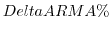
of ARMA predictions. The symbol denotes the relation
means the variance
of ARMA predictions. The symbol denotes the relation
 in percentages,
where
in percentages,
where  defines average errors of the Random Walk.
If ARMA predicts better then
defines average errors of the Random Walk.
If ARMA predicts better then 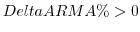 .
.
The data was divided into three equal parts.
The first part was applied to estimate parameters  and
and  of an ARMA model using different parameters
  and
and  .
.
The best values of and were defined using the
second part of data.
The third part was used to compare ARMA and RW models. The table shows the comparison results.
Table 1.1 demonstrates that the ARMA model predicts all the financial data not better than RW. However ARMA predicts call rates 31 percent better then RW. That is a statistically significant difference. The observed deviations between RW and ARMA models predicting financial data are to small for practical conclusions.
Figure 1.1 shows optimal parameters and . In this case the optimal  and
and  .
.
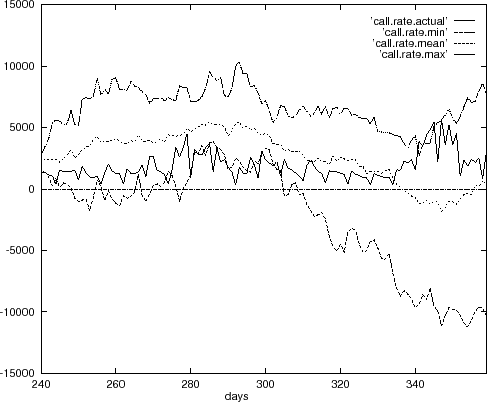
The "multi-day" predictions of call rates are shown in Figure 1.2.
![\begin{figure}\begin{codebox}{4.7in}
\begin{verbatim}b[0] = -2.888616e-01
a[...
...] = -1.432491e+03
a[11] = 8.030343e-01\end{verbatim}
\end{codebox}
\end{figure}](img79.png)