


Consider, for illustration, a simple example.
 .
The first data set
.
The first data set
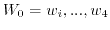 is for estimation of continuous parameters
  The second data set
  is for estimation of Boolean parameters
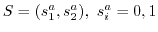 ,
where
,
where  suggest elimination of the continuous parameter
  . There are three feasible
  , namely

![[*]](file:/usr/share/latex2html/icons/footnote.png) .
.
Assume that unknown parameters depend on  this way
 and
and  .
.
In a case  the least square estimates are
  and
and  .
The prediction is
.
The prediction is  .
.
In a case  the least square estimate of the only remaining parameter is
  and the prediction is
  .
.
In a case  the least square estimate is
  and the prediction is
  .
.
The best prediction is provided by the structure
 . The reason is obvious: this structure eliminates
the highly unstable parameter
. The reason is obvious: this structure eliminates
the highly unstable parameter  .
Applying the structural stabilization one eliminates the nuisance parameter
.
Applying the structural stabilization one eliminates the nuisance parameter  and simplifies AR model (1.57)
 |
(57) |
(
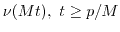 ) because it changes (see expression 1.58).
Various examples of structural optimization are described in [13] In the next section the structural optimization will be illustrated considering the case with external factors



