The traditional time series models assume that their parameters do not change. Examples are parameters  of the ARMA model, parameters
  of the ARFIMA model, parameters
  of the BL model, and parameters
 of the ANN model.
The variability of parameters of models describing the financial data such as stock rates and the currency exchange rates can be partially explained by the changes of economical conditions. However this variability is there even in the stable economical conditions. The reason is the "Feed-Back" processes. It is well known that the predictions may influence the supply and demand and consequently the future data.. In such cases the statistical best fit models should be complemented or replaced by the game-theoretical equilibrium models. However there is the possibility that the equilibrium model would be namely the Wiener process. That means that the market rates in economics are governed by the similar model as the Brownian motion in physics and are as unpredictable as the movement of individual molecules in gases. Table 1.1 shows that the simplest Wiener process, called as the Random Walk (RW), predicts the financial data at least as well as Arma models.
The objective of traditional time series models is to define such parameters that minimize a deviation from the available data.
One may call them as the best fit models.
The goodness of fit is described by continuous parameters  called as state variables. For example, in the ARMA model (see expression (1.1)) the state variables
 .
.
If the parameters remain constant in the future, then models that fit best to the past data will predict the future data as well. Otherwise, the best fit to the past data can be irrelevant or even harmful for predictions.
Models are needed which are not sensitive to the changes of system parameters. Such models may predict the uncertain future better by eliminating the nuisance parts from the structure of the model.
Trying to solve this problem we introduce a notion of the model structure. The model structure is determined by the Boolean parameters
 called as structural variables. A structural variable is equal to unit if the corresponding component of time series model is included . Otherwise, the structural variable is equal to zero. For example, in the ARMA model
 . Here
 , if the parameter
  is included into the ARMA model and
  , otherwise
![[*]](file:/usr/share/latex2html/icons/footnote.png) .
We search for such structure of the model that minimizes the prediction errors in the changing environment.
.
We search for such structure of the model that minimizes the prediction errors in the changing environment.
To achieve this we divide available data
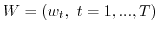 into two parts
 and
and
 .
.
The first part  is for estimation of continuous parameters
  which depends on Boolean structural parameters . The estimation is performed for a set of all feasible by minimizing the least square deviation.
The second part  is used to select such that
minimize the least square deviation. This means that the second part is for estimation of Boolean structural parameters.
is used to select such that
minimize the least square deviation. This means that the second part is for estimation of Boolean structural parameters.
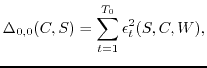
Denote by  the predicted value of a model
  with fixed parameters
  using the data
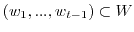 . The difference between the prediction and the actual data
  is denoted by
 . Denote by
  the fitting parameters which minimize the sum of squared deviations
 using the first data set
at fixed structure parameters .
using the first data set
at fixed structure parameters .
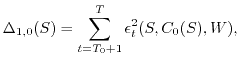
by minimizing the sum of squared deviations
 using the second data set and the fitting parameters
  that were obtained from the first data set
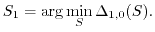
provide the best fit to the first data set at fixed structure . One stabilizes the structure
by minimizing the prediction errors for the second set of data while using the fitting parameters obtained from the first set of data . This way the stabilized structure
that were obtained from the first data set
provide the best fit to the first data set at fixed structure . One stabilizes the structure
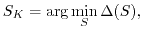
by minimizing the prediction errors for the second set of data while using the fitting parameters obtained from the first set of data . This way the stabilized structure  of
is obtained by eliminating unstable parameters and parts of the time series.
of
is obtained by eliminating unstable parameters and parts of the time series.
We consider two data sets and just for simplicity.
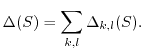
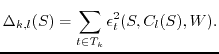
One may partition the data  into many data subsets
 . In this case we minimize the sum
 |
(53) |
 |
(54) |
into many parts one may obtain sequences  to short for the meaningful estimation of parameters
  if
if  is not very large. If is very large one may expect that most of the fitting parameters would be different
in different data subsets
is not very large. If is very large one may expect that most of the fitting parameters would be different
in different data subsets  and will be eliminated by the stabilization procedure (1.54). Therefore number
  seems reasonable
as the first stabilization attempt. One may try
seems reasonable
as the first stabilization attempt. One may try  later on.
The usefulness of the structural stabilization follows from the observation that any optimal
estimate of time series parameters using a part of the data
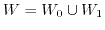 is optimal for another part
only if all the parameters remain the same. Otherwise one may obtain a better estimate eliminating the changing parameters from the model. For example in the case of changing parameters
is optimal for another part
only if all the parameters remain the same. Otherwise one may obtain a better estimate eliminating the changing parameters from the model. For example in the case of changing parameters
 of the ARMA model the best prediction may be obtained by elimination of all the parameters except
  (see Table 1.1).