Predictions often depend on several factors
In such a case multi-dimensional ARMA should be used.
Denote by
 the main statistical component and by
 the external factors. In such a case we extend the traditional ARMA model this way
 is the number of AR (Auto-Regression) components and
 is the number of MA (Moving Average) ones.
We say that continuous variables
is the number of MA (Moving Average) ones.
We say that continuous variables  and
and  define the state of the ARMA model (state variables). The discrete parameters , , and
  define the structure (structural variables). The structural
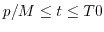
variable defines the time when we start scanning the time series for the optimization of state variables
define the structure (structural variables). The structural
variable defines the time when we start scanning the time series for the optimization of state variables  . Denote by
  the scanning end .
That means that first for the fixed structural variables
the scanning end .
That means that first for the fixed structural variables 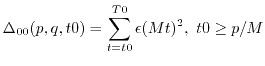 we minimize the squared deviation
 and
and
 is from expression (1.60) . Denote the optimal values
  and
and  .
.
At fixed the optimal values of  are defined by a system of linear equations
calculated from the condition that all the partial derivatives
are defined by a system of linear equations
calculated from the condition that all the partial derivatives
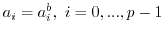 of the sum (1.60) are zero.
Thus obtaining the least squares estimates
of the sum (1.60) are zero.
Thus obtaining the least squares estimates
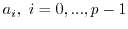 at given
we have to solve linear equations with variables
at given
we have to solve linear equations with variables
 (see chapter 1.3 for details).
The optimization of the discrete structural variables is performed using a different data set that starts at and ends at  while keeping the previous optimal values of the state variables
  and obtained by minimization of the sum
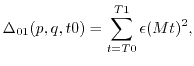 using the data from to .
Here the sum
using the data from to .
Here the sum