


In many cases one wants to predict for several days (hours, weeks, months, e.t.c) ahead. We call that as "Multi-Step Prediction (MSP)".
A simple way to do that is by using
some type of Monte Carlo simulation.
The residuals  (see expression (1.44)) are determined up to
the simulation starting moment
(see expression (1.44)) are determined up to
the simulation starting moment  using the observed data.
The rest of residuals
using the observed data.
The rest of residuals
 are generated
by a Gaussian distribution with zero mean and variance
are generated
by a Gaussian distribution with zero mean and variance  .
The simulation is repeated
.
The simulation is repeated  times
Considering external factors we just replace them by the
nearest previous values (see section 1.4.1).
The illustration is in Figure 1.2
times
Considering external factors we just replace them by the
nearest previous values (see section 1.4.1).
The illustration is in Figure 1.2
The line denoted as
 shows the observed call rate.
The lines
shows the observed call rate.
The lines  ,
,
 , and
, and  show the minimal, the average, and the maximal results of MSP predictions.
The "min" and "max" lines denote the lower and the upper
values of simulation.
Therefore, these lines are referred to as "MSP-
confidence intervals", meaning that
if the model is true, one may expect those "intervals"
to cover the real data with some "MSP-confidence level"  .
It is very difficult to define exactly. Assuming that
"interval deviations" may be regarded as independent and uniformly
distributed random variables, we obtain
.
It is very difficult to define exactly. Assuming that
"interval deviations" may be regarded as independent and uniformly
distributed random variables, we obtain
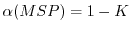 .
Here is the number of Monte-Carlo repetitions. In the example,
.
Here is the number of Monte-Carlo repetitions. In the example,  ,
thus
,
thus
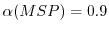
Unfortunately, this assumption "over-simplifies" the statistical model.
Therefore, one may regard "MSP-confidence levels"
merely as a Monte-Carlo approximation.