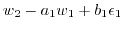
We define residuals by
recurrent expressions:
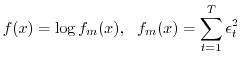
The logarithm is used to decrease the objective variation by improving the scales.
The objective  depends on
 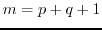 unknown parameters that are
represented as an
unknown parameters that are
represented as an  -dimensional vector
 .
.
It is easy to see from (1.44), (1.39), and (1.37)
that residuals  are
linear functions of the parameters
are
linear functions of the parameters  .
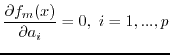
This means that the minimum conditions
.
This means that the minimum conditions
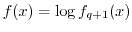
 as a function of
parameters
as a function of
parameters
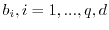 . It reduces the number of
parameters of non-linear optimization to
. It reduces the number of
parameters of non-linear optimization to  .
.
The system
depend on  as polynomials of degree
  .
.
The equation
 as
a polynomial of degree
as
a polynomial of degree  , where is a truncation parameter.
These imply that, in general, the objective is a multi modal function
of parameters and

![[*]](file:/usr/share/latex2html/icons/footnote.png) . Therefore, one has to consider the methods of
global optimization (see, [14]).
. Therefore, one has to consider the methods of
global optimization (see, [14]).
Denote
 |
 - components that represent the parameters
 .
.
There is no variance  in expressions
(1.49) and (1.44). If necessary, we have to estimate the
variance by some other well known techniques.
in expressions
(1.49) and (1.44). If necessary, we have to estimate the
variance by some other well known techniques.