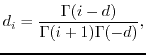
The stationarity of time series is assumed in ARMA, ANN, and BL models. That is a simplification of reality. A well known source of non-stationarity is a linear component, the trend. One can eliminate the trend by differencing, since derivatives of linear functions are constant. The elegant extension of this idea is the Auto-Regression Fractionally-Integrated Moving-Average Model (ARFIMA).
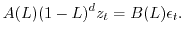
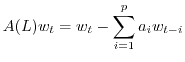
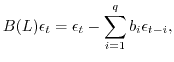
We define an ARFIMA![[*]](file:/usr/share/latex2html/icons/footnote.png) process as the folowing time series
process as the folowing time series

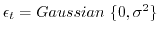 .
.
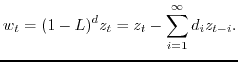
We define the transformation  as follows:
 is a fractional integration parameter, and
  is a
gamma function.
is a
gamma function.
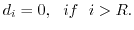
We assume that
 is the truncation parameter, the number of non-zero components.