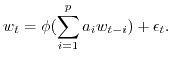
into the standard Auto-Regression (AR) model
roughly
represents the activation of a real neuron.
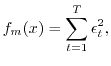
We minimize the sum
into the standard Auto-Regression (AR) model
roughly
represents the activation of a real neuron.
We minimize the sum
 depends on
  unknown parameters represented as a -dimensional vector
 .
.
From expression (1.31) it is clear that
the residuals  are
nonlinear functions of parameters
are
nonlinear functions of parameters  if the activation function is nonlinear
![[*]](file:/usr/share/latex2html/icons/footnote.png) .
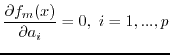
This means that the minimum conditions
.
This means that the minimum conditions
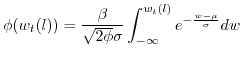
An interesting activation function is derived using the Gaussian distribution function
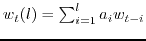 and
and  is a scale parameter. The function (1.34) is different from the activation of a real neuron but is convenient for analysis.
Using activation function (1.34) sum (1.31) depends on
the parameters
 , too.
These parameters are unknown, as usual. Therefore they should be optimized together with the parameters
, too.
These parameters are unknown, as usual. Therefore they should be optimized together with the parameters  .
In such a case the objective depends on
.
In such a case the objective depends on  unknown parameters represented as a -dimensional vector
 .
.
That is the main difference of model (1.34) from the traditional ANN models where the activation functions are selected by their resemblance to the natural ones defined using the biophysical experimentation. In this research the resemblance factor is neglected and the activation function (1.34) is regarded just as a reasonable non-linearity that should be adapted to the available data.
Obviously, using ANN one meets the multi-modality problem as it was in a case of ARMA model (see non-linear equations (1.11)). The multi-modality problems of ANN models are discussed in [].