next up previous
Next: Optimization of MA parameters Up: Minimization of Residuals of Previous: Minimization of Residuals of

Optimization of AR parameters

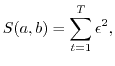
Denote

$\displaystyle S(a,b) =\sum_{t=1}^T \epsilon^2,$     (10)

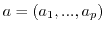
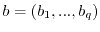
where $a=(a_1,...,a_p)$ and $b=(b_1,...,b_q)$.

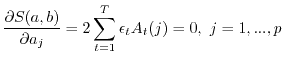
From expressions (1.11) and (1.8) the minimum condition is

$\displaystyle {\partial S(a,b) \over \partial a_j} =
2 \sum_{t=1}^T \epsilon_t A_t(j)=0,\ j=1,...,p$     (11)

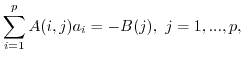
or
$\displaystyle \sum_{i=1}^p A(i,j) a_i = -B(j),\ j=1,...,p,$     (12)

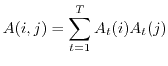
where
$\displaystyle A(i,j) =\sum_{t=1}^T A_t(i) A_t(j)$     (13)

and
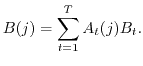
$\displaystyle B(j) =\sum_{t=1}^T A_t(j) B_t.$     (14)

The minimum of expression (1.11) at fixed parameters $b$ is defined by a system of linear equations:

$\displaystyle a(b)= A^{-1} B.$     (15)

Here matrix $A=(A(i,j),\ i,j=1,...p)$ and vector $B=(B(j), \ j=1,...p)$, where elements $A(i,j)$ are from (1.14), components $B(j)$ are from (1.15), and $A^{-1}$ is an inverse matrix $A$. This way one define the vector $a(b)=(a_i(b),\ i=1,...,p)$ that minimize sum (1.11) at fixed parameters $b$.


next up previous
Next: Optimization of MA parameters Up: Minimization of Residuals of Previous: Minimization of Residuals of
mockus 2008-06-21