Next: 2 SOFTWARE FOR GLOBAL Up: 1 ABOUT THE BAYESIAN Previous: 1 GENERAL IDEAS Contents Index
The reason for such special attention is that the knapsack
problem is a simple example of important family of NP-complete
problems![[*]](footnote.png) . Note, that
this example is good mainly for illustration of BHA and alternative
approaches.
The reason is that the simple greedy heuristic of the knapsack
problem is very efficient. Therefore, only marginal improvements can
be made by more sophisticated methods, including BHA. In scheduling problems, such as the flow-shop
and batch scheduling [Mockus et al., 1997], BHA works
more efficiently. However,
the scheduling problems are more difficult for explanations. Thus, we
start the explanations by the knapsack problem.
. Note, that
this example is good mainly for illustration of BHA and alternative
approaches.
The reason is that the simple greedy heuristic of the knapsack
problem is very efficient. Therefore, only marginal improvements can
be made by more sophisticated methods, including BHA. In scheduling problems, such as the flow-shop
and batch scheduling [Mockus et al., 1997], BHA works
more efficiently. However,
the scheduling problems are more difficult for explanations. Thus, we
start the explanations by the knapsack problem.
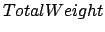
The knapsack problem is to maximize the total value of a
collection of objects when the total weight  of these objects
is limited. Denote values of objects
of these objects
is limited. Denote values of objects  by
by  and their
weights by
and their
weights by  .
.
 depends on
  Boolean variables
 .
.
 means that a collection of objects
 is selected. The value of the collection is
 . This collection is described by the decision
vector
. This collection is described by the decision
vector
 . The simplest exact
algorithm is to compare all the collections:
. The simplest exact
algorithm is to compare all the collections:
 ,
,
 ,
,
 .
denotes the most valuable
collection satisfying the weight
limit that is obtained during
.
denotes the most valuable
collection satisfying the weight
limit that is obtained during  iterations. The best current collection is updated during the
recording operation in step two. It is replaced by better current
collection. The exhaustive search of all the decisions needs
iterations. The best current collection is updated during the
recording operation in step two. It is replaced by better current
collection. The exhaustive search of all the decisions needs
 of iterations. This means
  of time, where the
constant
of time, where the
constant  is the observation time (the CPU time needed to
evaluate sum (2.1) and to test inequality
(2.2)).
is the observation time (the CPU time needed to
evaluate sum (2.1) and to test inequality
(2.2)).
 , branch 1:
  ,
,


 ,
,
 and the time is
  . Usually,
the time
. Usually,
the time  is much less then the exact upper limit
  . However, this limit may be approached. For example, if all
the prices and weights are almost equal. In such
a case no branches will be cut. That is a reason why approximate
algorithms are preferred, if is large.
. However, this limit may be approached. For example, if all
the prices and weights are almost equal. In such
a case no branches will be cut. That is a reason why approximate
algorithms are preferred, if is large.
 with
probability
,
with
probability
,
 .
.
 of previous samples. In cases with replacement, one does
not know when the optimum is reached. Therefore, MC stops, if the
time allocated for the optimization is exhausted.
This algorithm converges to an exact solution with probability
one, if the number of iterations
of previous samples. In cases with replacement, one does
not know when the optimum is reached. Therefore, MC stops, if the
time allocated for the optimization is exhausted.
This algorithm converges to an exact solution with probability
one, if the number of iterations
 . However,
the convergence is very slow, nearly logarithmic. Note, that the
time
. However,
the convergence is very slow, nearly logarithmic. Note, that the
time  is not a limit for MC with replacement.
 as the specific value of the object
object with the highest
heuristic :
with the best heuristic in the
starting list,
, where
as the specific value of the object
object with the highest
heuristic :
with the best heuristic in the
starting list,
, where
 is number of the last iteration.
 .
The inequality is there because objects are gradually removed from
the starting list.
The algorithm may stick in some non optimal decision. The greedy
heuristic is obviously useless, if the specific values are
equal
.
The inequality is there because objects are gradually removed from
the starting list.
The algorithm may stick in some non optimal decision. The greedy
heuristic is obviously useless, if the specific values are
equal
 . In such cases the outcome depends
on the numeration of objects.
. In such cases the outcome depends
on the numeration of objects.
with some probability  that is proportional to
the specific value ,
from the starting list at random
with the probability ,
,
,
that is proportional to
the specific value ,
from the starting list at random
with the probability ,
,
,
 by restoring starting list to
the initial state (as a set of all the objects) and return to
step 1,
by restoring starting list to
the initial state (as a set of all the objects) and return to
step 1,
 iterations and record the best
current collection
iterations and record the best
current collection  .
.
The algorithm is expected to be better than Monte-Carlo, too,
since it includes an expert knowledge by relating the decision
probabilities to heuristics.
.
.
The algorithm is expected to be better than Monte-Carlo, too,
since it includes an expert knowledge by relating the decision
probabilities to heuristics.
iterations. That
is a traditional way.
One solves the same problem in a more general setup by considering a "mixture" of different heuristic algorithms. For example,
 ,
,
 ,
,
 .
.
 with some probability
  that is
defined by probability distribution
that is
defined by probability distribution
 :
at random with probability
,
:
at random with probability
,
 ,
by returning to
step 1,
iterations and record the best
current collection , denote its value by
,
by returning to
step 1,
iterations and record the best
current collection , denote its value by
 .
.
 is the best result obtained using times the
Mixed Randomization with the probability distribution
is the best result obtained using times the
Mixed Randomization with the probability distribution  .
.
That is a way to extend a family of possible decisions from the
discrete set
 to the continuous
one. That is important because the best results we often obtain
using a mixture of algorithms [Mockus et al., 1997].
to the continuous
one. That is important because the best results we often obtain
using a mixture of algorithms [Mockus et al., 1997].
Here we mixed three approximate algorithms: the Monte Carlo, the Linear Randomization and the Greedy Heuristics. Following expressions define a larger family of different approximate algorithms, including these three
denotes the Monte-Carlo randomization. The superscripts
 define a family of
"polynomial" randomizations. The superscript
define a family of
"polynomial" randomizations. The superscript  denotes the
greedy heuristics with no randomization.
The Mixed Randomization means using randomization functions
denotes the
greedy heuristics with no randomization.
The Mixed Randomization means using randomization functions
 with probabilities and
recording the best result obtained during
iterations.
is difficult because is
a stochastic function and the multimodal one, as usual. A
natural way to consider such problems is by regarding functions
as samples of a stochastic function defined by some
prior distribution. The next observation is obtained by
minimizing the expected deviation from the exact solution. This
technique is called the Bayesian Heuristic Approach (BHA)
[Mockus et al., 1997].
with probabilities and
recording the best result obtained during
iterations.
is difficult because is
a stochastic function and the multimodal one, as usual. A
natural way to consider such problems is by regarding functions
as samples of a stochastic function defined by some
prior distribution. The next observation is obtained by
minimizing the expected deviation from the exact solution. This
technique is called the Bayesian Heuristic Approach (BHA)
[Mockus et al., 1997].
In the knapsack problem, the complete collection  is a set
of all objects. The initial collection is a set of objects
is a set
of all objects. The initial collection is a set of objects
 satisfying the inequality
 . The value of this
collection is
. The value of this
collection is  . A complement of the initial set
  is denoted
  . We denote permuted collections as
 and values of these collections as
 . We define the direct permutation heuristics as
 and
and  are used sometimes instead of
the short ones
are used sometimes instead of
the short ones  and
and  .
We define the normalized permutation heuristics as
.
We define the normalized permutation heuristics as
 and
and
 .
Normalized heuristics (2.9) can be easily
converted into probabilities by expressions such as
(2.6). Direct heuristics (2.8) are
convenient in some well-known algorithms, such as Simulated
Annealing.
Here is an example of permutation algorithm using linear
randomization:
.
Normalized heuristics (2.9) can be easily
converted into probabilities by expressions such as
(2.6). Direct heuristics (2.8) are
convenient in some well-known algorithms, such as Simulated
Annealing.
Here is an example of permutation algorithm using linear
randomization:
 feasible changes
 of the
initial collection , by replacing randomly selected
objects using this algorithm
of the
initial collection , by replacing randomly selected
objects using this algorithm
 from initial collection ,
 from complement
 of the initial
collection, skip this step if the complement is empty,
into the initial collection,
for all
the changes
of the initial
collection, skip this step if the complement is empty,
into the initial collection,
for all
the changes  ,
,
 by
expression (2.13),
at random with probability ,
,
iterations and record the best current collection .
by
expression (2.13),
at random with probability ,
,
iterations and record the best current collection .
 ,
,
 , the new collection
  is selected with probability one,
 , the new collection is selected with probability
that declines exponentially,
is the iteration number and is the "initial
temperature." The difference of this formulation from
traditional simulating annealing algorithms is that we optimize
the parameter for some fixed number of iterations . We
disregard the asymptotic behavior. The asymptotic properties are
beyond the scope of the Bayesian Heuristics Approach.
, the new collection is selected with probability
that declines exponentially,
is the iteration number and is the "initial
temperature." The difference of this formulation from
traditional simulating annealing algorithms is that we optimize
the parameter for some fixed number of iterations . We
disregard the asymptotic behavior. The asymptotic properties are
beyond the scope of the Bayesian Heuristics Approach.
is called the population of the th generation. The
population evolves for a prescribed number  of generations.
The basic structure processed by GA is the string. Strings are
composed of a sequence of characters.
of generations.
The basic structure processed by GA is the string. Strings are
composed of a sequence of characters.
A simple GA consists of
- one reproductive plan, defined as
the fitness proportional reproduction
- two genetic operators,
defined as crossover and mutation.
The probability of selection
is defined in proportion to the fitness of individuals
During the crossover operation one splits two selected strings at
some random position  . Then two new strings are created, by
exchanging all the characters up to the split point .
During the mutation operation one alters some string characters at
random. A mutation is of -th order, if one changes
elements during one mutation operation. Both the crossover and
the mutation are feasible, if they satisfy all constraints.
. Then two new strings are created, by
exchanging all the characters up to the split point .
During the mutation operation one alters some string characters at
random. A mutation is of -th order, if one changes
elements during one mutation operation. Both the crossover and
the mutation are feasible, if they satisfy all constraints.
It follows from this definition that GA may be considered as a special case of the Permutation and Randomization. Thus, one may include GA into the framework of Bayesian Heuristic Approach. We illustrate that by using the Knapsack problem as an example.
 is represented as the Boolean vector
collection
is represented as the Boolean vector
collection  is . The probability to select a string
is
is the normalized
permutation heuristics
is . The probability to select a string
is
is the normalized
permutation heuristics
 and
and
 .
.
During the crossover operation one splits two selected strings at
some random position  . Then two new strings are
created, by exchanging all the characters up to the split point
.
. Then two new strings are
created, by exchanging all the characters up to the split point
.
During the mutation operation one produces mutants by
inverting randomly selected components  of the Boolean
vector
of the Boolean
vector  . A mutation is of -th order, if one
changes
. A mutation is of -th order, if one
changes
 components during one mutation
operation. A mutant is fertile, if it satisfies all the
constraints.
components during one mutation
operation. A mutant is fertile, if it satisfies all the
constraints.
Denote by  a current collection at th
iteration. Denote by the best current collection
obtained during iterations.
a current collection at th
iteration. Denote by the best current collection
obtained during iterations.
Here is an example of a simple GA algorithm written in BHA terms. The algorithm is similar to that of Permutation.
of fertile mutants by replacing
randomly selected objects using feasible changes
of the initial collection ,
 for all
these mutants using expression (2.14),
by expression (2.13),
for all
these mutants using expression (2.14),
by expression (2.13),
 and
and  at random
with probabilities ,
at random with probability
at random
with probabilities ,
at random with probability 
 and
and
 of these two mutants,
reflecting cross-over results
using (2.13)
,
of these two mutants,
reflecting cross-over results
using (2.13)
,

 fertile mutants by feasible changes of the current
collection,
,
by
expression (2.13),
,
fertile mutants by feasible changes of the current
collection,
,
by
expression (2.13),
,
 and return to step 11,
iterations and record the best current collection
.
and return to step 11,
iterations and record the best current collection
.
Thus, the crossover operation "improves" the population, if the "traits" assumption is true. If not, then the crossover may be considered merely as a sort of mutation. That may help to jump the area dividing separate "local" minima. However, the similar jump may be accomplished by high order mutations, too.
As usual [Androulakis and Venkatasubramanian, 1991], mutations are considered as
more "radical" operations as compared with crossovers. That is
correct, if one changes many elements of the "genetic" sequence during
one mutation. This happens, if the mutation order is close to
the string length .
The results of some real life examples of network optimization
[Mockus, 1967] and parameter grouping
[Dzemyda and Senkiene, 1990] show that
low order mutations, when merely a few elements of the decision
vector  are changed, work better. In such cases, the
mutation may be considered as a less radical operation because
fewer components of the vector are changed, as compared with
the crossover operation.
are changed, work better. In such cases, the
mutation may be considered as a less radical operation because
fewer components of the vector are changed, as compared with
the crossover operation.
We may improve efficiency of the
simple GA algorithm by using the crossover rate (see step
eleven of the algorithm) as an optimization variable in the
framework of BHA. This was applied solving the Batch
Scheduling problems [Mockus et al., 1997].
If the crossover
rate is considered as a time function [Androulakis and Venkatasubramanian, 1991], the parameters of this function can be optimized using BHA.
and weights are generated
randomly. In the Java case,  reflects a real life
example [Malisauskas, 1998]. The optimal probability
reflects a real life
example [Malisauskas, 1998]. The optimal probability  of the greedy
heuristic
of the greedy
heuristic  is near to one, but not exactly one.
Some degree of randomization helps to escape non optimal
decisions.
The randomized procedures
is near to one, but not exactly one.
Some degree of randomization helps to escape non optimal
decisions.
The randomized procedures
 are defined by
(2.6) and (2.7). Both the software versions
consider just three components.
are defined by
(2.6) and (2.7). Both the software versions
consider just three components.
The  version uses the Monte Carlo, the Linear and the
Quadratic randomizations. Corresponding optimization parameters
are
version uses the Monte Carlo, the Linear and the
Quadratic randomizations. Corresponding optimization parameters
are
 . The Monte Carlo and Linear
randomizations and the Pure Greedy heuristic are applied in the
Java version. Corresponding
optimization parameters are
. The Monte Carlo and Linear
randomizations and the Pure Greedy heuristic are applied in the
Java version. Corresponding
optimization parameters are
 .
.
We are looking for such probability distribution that
provides the maximal after iterations. Bayesian
methods [Mockus, 1989a,Mockus and Mockus, 1990,Mockus et al., 1997] are used for
that.
and weights is considered. The results of BHA and the exact
deterministic B&B algorithms are in Table 2.1.
Average results were obtained by repeating the optimization
procedures  times at fixed parameters and probability distribution .
 , and , and  |
|||||||
 |
 |
 |
 |
 |
 |
 |
 |
| 50 | 313 | 9.56057 | 9.62347 | 0.654 | 0.0114 | 0.0280 | 0.9605 |
| 100 | 526 | 13.0703 | 13.1241 | 0.411 | 0.0316 | 0.0412 | 0.9271 |
| 150 | 771 | 16.6301 | 16.6301 | 0.000 | 0.0150 | 0.1945 | 0.7904 |
| 200 | 875 | 37.4665 | 37.4859 | 0.050 | 0.0315 | 0.0530 | 0.9437 |
| 250 | 568 | 53.7781 | 53.9000 | 0.226 | 0.0091 | 0.0511 | 0.9397 |
| 300 | 1073 | 28.3144 | 28.6106 | 1.034 | 0.0113 | 0.0835 | 0.9050 |
| 350 | 1416 | 30.4016 | 31.7527 | 4.254 | 0.0064 | 0.0646 | 0.9288 |
| 400 | 2876 | 32.1632 | 33.3192 | 3.469 | 0.0202 | 0.0452 | 0.9344 |
| 450 | 1038 | 105.467 | 105.578 | 0.105 | 0.0101 | 0.0149 | 0.9748 |
| 500 | 2132 | 39.3583 | 42.1047 | 6.521 | 0.0078 | 0.1556 | 0.8365 |
 is the number of objects.
is the number of repetitions.
is the number of objects.
is the number of repetitions.  is the total
number of observations by the Bayesian method. is
the number of nodes considered by the exact method. is the best result of the Bayesian method.
is the exact optimum. is the mean
percentage error of the Bayesian algorithm.
is the total
number of observations by the Bayesian method. is
the number of nodes considered by the exact method. is the best result of the Bayesian method.
is the exact optimum. is the mean
percentage error of the Bayesian algorithm.
 ,
are optimized probabilities of different randomizations
obtained using a Bayesian method.
If the deviation of some solution does not exceed
,
are optimized probabilities of different randomizations
obtained using a Bayesian method.
If the deviation of some solution does not exceed  , we call
this a solution. One can expect that the solution
satisfies the applications, where the level of data uncertainty
is not less than .
, we call
this a solution. One can expect that the solution
satisfies the applications, where the level of data uncertainty
is not less than .
Table 2.1 shows that we need to consider from 313 to
2876 nodes to obtain the exact solution. Only 100 observations
are needed to obtain the solution by the Bayesian method.
The deviation exceeds  only for three cases in ten. The
average deviation is
only for three cases in ten. The
average deviation is  .
.
Assume that roughly the same computing time is necessary for one
node and for one observation. Then the Bayesian
solution is about three times "cheaper" as compared to the
exact one, if the number of objects is fifty. If this number is
400, then the Bayesian solution is almost thirty times
cheaper.
Other examples, in particular ones applying BHA to a family of
scheduling problems [Mockus et al., 1997] show higher efficiency
of BHA.
of the Monte Carlo randomization,
the linear randomization, and the pure greedy heuristic. The
aim is to show how BHA works while solving a real life knapsack
problem. The example illustrates how to apply the Java software
system for global optimization called as GMJ1. Therefore, several
figures are included. They illustrate the input and output of GMJ1
graphical interface.
|
(double),
(double),
 of the GMJ1 system.
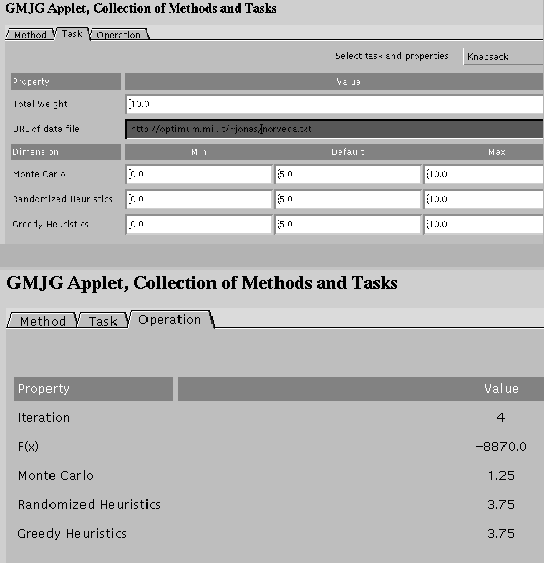
Figure 2.1 shows a fragment of the file
'Knapsack.java'
of the GMJ1 system.
Figure 2.1 shows a fragment of the file
'Knapsack.java'
On  fields,
On the  fields,
 ,
,
 ,
,
 .
show the proportions of each method. The
mixture of three methods of picking objects is considered: the
Monte Carlo, the Linearly Randomized Heuristics and the pure
Greedy Heuristics. Probabilities
.
show the proportions of each method. The
mixture of three methods of picking objects is considered: the
Monte Carlo, the Linearly Randomized Heuristics and the pure
Greedy Heuristics. Probabilities  of methods
  are related to the proportions this way
 .
Figure 2.2 (bottom) shows the output page that opens when
the computing is completed. Here
.
Figure 2.2 (bottom) shows the output page that opens when
the computing is completed. Here  means the iteration
number where the best value was reached.
means the iteration
number where the best value was reached.  defines the best
value, "Monte Carlo." "Randomized Heuristics," and "Greedy
Heuristics" show the optimal part of each of the three methods
in the mixture.
defines the best
value, "Monte Carlo." "Randomized Heuristics," and "Greedy
Heuristics" show the optimal part of each of the three methods
in the mixture.
Figure 2.3 (top) shows how the best value of
changes subject to the iteration number.
Figure 2.3 (bottom) shows how changes subject to
proportions of the Monte Carlo randomization.
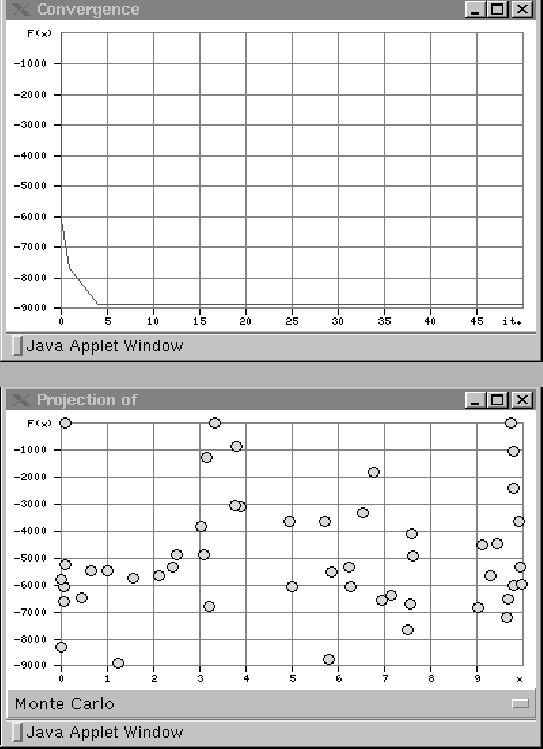 |
Figure 2.4 (top) shows how changes subject to
proportions of the linear randomization.
Figure 2.4 (bottom) shows how changes subject to
proportions of the pure greedy heuristics.
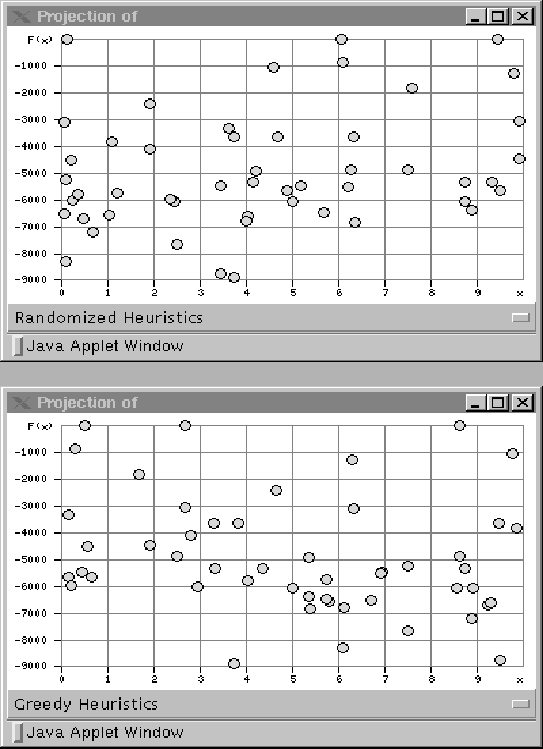 |
It is hard to notice any regularity in the  windows
in Figures 2.3 (bottom), and 2.4.
The reason is that all the variables change together during the
optimization. To see good projections, one uses the method
windows
in Figures 2.3 (bottom), and 2.4.
The reason is that all the variables change together during the
optimization. To see good projections, one uses the method  . Variables
change one by one in this method (see Figures 9.4 and 9.5).
. Variables
change one by one in this method (see Figures 9.4 and 9.5).
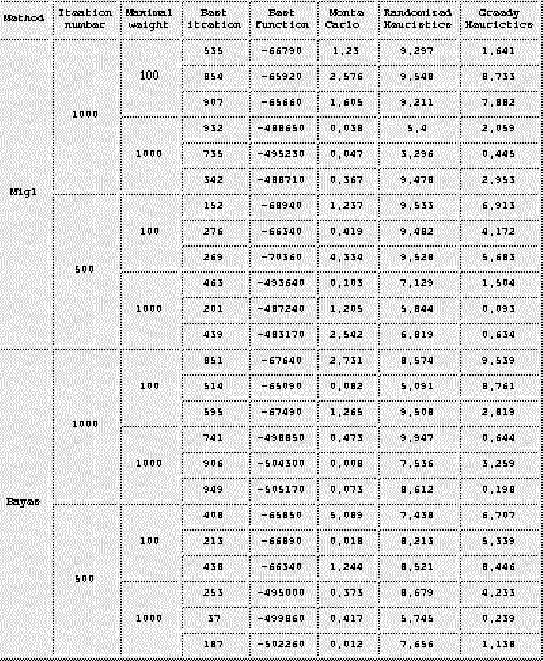
. The sixth, the
seventh, and the eighth column define the optimal mixture of
three search methods. These mixtures can be expressed in
percentage terms dividing each of the three numbers by their
sum and multiplying by 100.
The results suggest that
 ,
is
high, the greedy heuristic is almost useless (the optimal
mixture
,
is
high, the greedy heuristic is almost useless (the optimal
mixture
 meaning that the greedy heuristics
part is just 1/15,
is
low, the greedy heuristic is essential (the optimal mixture
meaning that the greedy heuristics
part is just 1/15,
is
low, the greedy heuristic is essential (the optimal mixture
 because the greedy heuristics part is
ten times greater.
because the greedy heuristics part is
ten times greater.
Now we consider some related problems. In these problems there are no obvious heuristics. Therefore, designing BHA algorithms one should consult experts. The experts may define decision rules defining greedy heuristics or suggest initial solutions needed for permutation heuristics.
The objective is to collect the minimal number of trains to remove cars from a goods-station.
Optimization variables are  . Here
 denotes a car and
  denotes a train.
The Boolean variable
denotes a train.
The Boolean variable  , if
the car is assigned to the train
, if
the car is assigned to the train  . Otherwise
  .
.
The constraints are
 is the weight of car .
 is the maximal weight of train .
 is length of car .
 is maximal length of train .
The objective function is the number of trains
The task is to cut a rod of length  into pieces of
length
into pieces of
length
 with minimal waist
  .
Optimization variables are
.
Optimization variables are  .
.
Here
denotes a segment.
 defines an ordinal
number of the segment.
defines an ordinal
number of the segment.
The Boolean variable  ,
if
the segment is assigned to the rod with ordinal number
,
if
the segment is assigned to the rod with ordinal number  .
.
Otherwise,  .
.
The
constraint is
is length of segment including the saw section.
is length of rod.
No gaps between segments.
The objective function is the waist.
The waist  is defined as the difference between
the length of the rod and the sum
is defined as the difference between
the length of the rod and the sum  of lengths of all the segments cut,
 .
One needs the optimization, if the sum of lengths of all segments to be cut
.
One needs the optimization, if the sum of lengths of all segments to be cut  .
.
 rods of length
 to be cut into segments
then one minimizes the total waist
to be cut into segments
then one minimizes the total waist
 ,
,
 ,
,
 ,
is denotes a segment.
denotes a rod,
defines an ordinal
number of the segment in the rod .
,
is denotes a segment.
denotes a rod,
defines an ordinal
number of the segment in the rod .
The Boolean variable  ,
if
the segment is assigned to the rod with ordinal number .
,
if
the segment is assigned to the rod with ordinal number .
Otherwise .
The optimization is needed if
 .
.
is the length of a segment . Using randomization techniques this means assigning higher probabilities to segments of greater length.
boards with minimal waist. There are timbers.
Optimization variables are  .
is denotes a board.
denotes a timber.
defines an ordinal
number of the board in the timber .
.
is denotes a board.
denotes a timber.
defines an ordinal
number of the board in the timber .
The Boolean variable ,
if
the board is assigned to the timber with ordinal number .
Otherwise .
The
constraints are
is width of board including the saw section.
 is diameter of timber
at the location of board .
depends
on the order and of boards in the timber and their thickness .
No gaps between boards.
is diameter of timber
at the location of board .
depends
on the order and of boards in the timber and their thickness .
No gaps between boards.
The objective function is the waist
 .
The waist
is defined as the difference between
the cross-section area of all timbers used and the sawn section of all boards produc
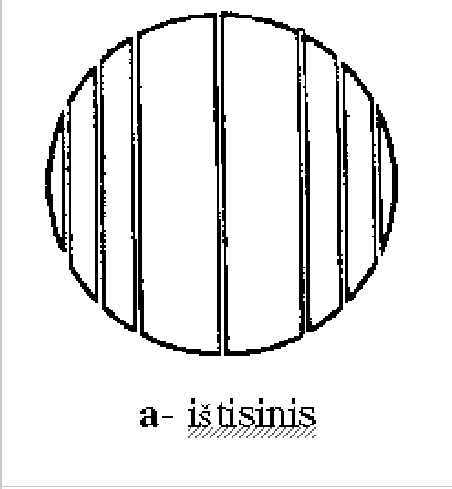
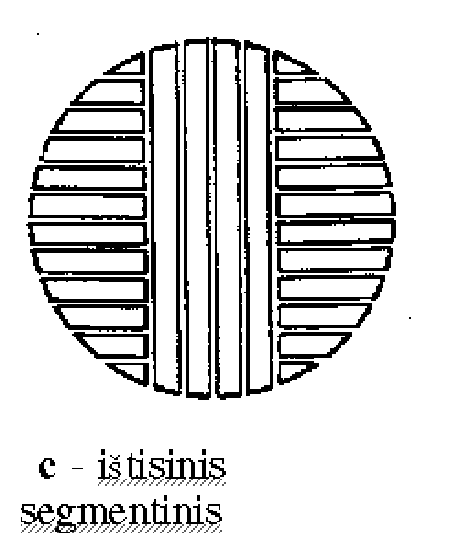
Expression (2.21) defines constraints for the simple composition of timbers (see Figure 2.6)
.
The waist
is defined as the difference between
the cross-section area of all timbers used and the sawn section of all boards produc
Expression (2.21) defines constraints for the simple composition of timbers (see Figure 2.6)
One minimizes the extended costwhile keeping some health constraints
denotes an item of diet,
denotes the unit price,
 is the number of units,
 is the amount of pleasure, obtained while consuming a unit of the food and estimated as some benefit in money terms,
 is the amount of calories in the item ,
 is the amount of some basic food ingredients ,
such as proteins, hydrocarbons, fats, etc.,
contained in a unit of item ,
is the amount of some basic food ingredients ,
such as proteins, hydrocarbons, fats, etc.,
contained in a unit of item ,
 defines amounts needed to keep healthy,
 the unpleasant
results due to excess calories estimated ass some losses in money terms.
the unpleasant
results due to excess calories estimated ass some losses in money terms.
by continuous ones. This way the Mixed Integer Linear Programming (MILP) problem is reduced to the simple
Linear Programming (LP).
The disadvantages are large round-off errors.
The rounding uncertainty of binary variables makes LP solution almost irrelevant.
 .
.
 .
.
 and
and  because the number of different is
 .
.
The practical advantage of the formulation (2.25)-(2.28) is that using this formulation one can directly apply all the heuristic methods described in the knapsack example.
The specific structure of the diet problem is exploited by defining the greedy heuristics or by setting a proper initial diet to be improved later by permutations. The second way seems convenient for the diet problem, because one just improves the diet that a person already likes. By using greedy heuristics one designs new diets from scratch. In all the cases the BHA helps to optimize the heuristic parameters (see the section 2).
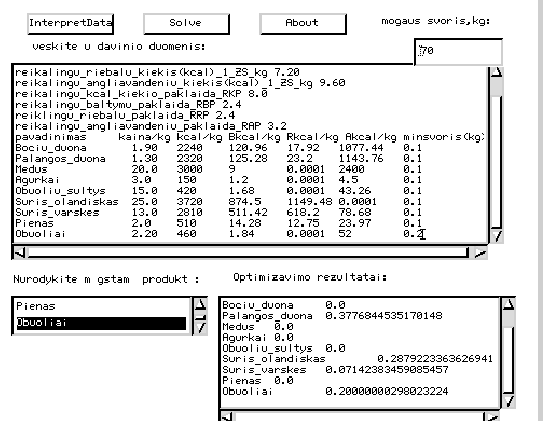
The Figure 2.8
shows the input data and the results of optimization. The selected list reflects the vegetarian taste. The most favored item are apples.The upper window shows the selected list and related data. The lower-right window shows the optimization results.
Note, that there are only four non-zero items because there are only four constraints defining lower limits for calories, proteins, fats and carbohydrates. This is a specific property of the linear programming solutions.
The problem is to minimize the total path length of a salesman
visiting cities and returning home (see[Miller and Pekny, 1991]).
Formally, a decision is a sequence of numbers
 that defines the sequence of visits to diferent cities
 .
.
A
decision is feasible  if there are no gaps in the path. The feasible decision is optimal if
 is the length of path .
 defines coordinates
of the city number
defines coordinates
of the city number  .
In the two-dimensional space
.
In the two-dimensional space
 .
The distances between the cities are defined as Euclidean distances
between the corresponding points
.
The distances between the cities are defined as Euclidean distances
between the corresponding points  .
.
In the following numerical experiments "cities" are considered to be points  in the
ten-dimensional unit cube [Mockus et al., 1997]. The multi-dimensional case is convenient for comparison of different methods.
The reason is that the choice of alternative paths is wider here.
in the
ten-dimensional unit cube [Mockus et al., 1997]. The multi-dimensional case is convenient for comparison of different methods.
The reason is that the choice of alternative paths is wider here.
Besides, in some real life traveling salesman problems, more then two dimensions are regarded.
For example, if a global traveling salesman is sensitive to the time lag then the third dimension is time.
If a product
passes through many separate reactors then one minimizes differences of some parameters between adjacent reactors, in addition to geometric coordinates.
Consider the heuristics
 is with the minus sign, because we regard greater heuristics as the better ones.
The greedy decision is to visit nearest new city
is with the minus sign, because we regard greater heuristics as the better ones.
The greedy decision is to visit nearest new city

Considering the knapsack example the compromise between the efficiecy of pure greedy heuristics and the convergence conditions is provided by adding deterministic component (2.34) representing greedy heuristics to the stochatsic components represented as polynomial (2.33).
denotes the Monte-Carlo randomization. The superscripts
define a family of
"polynomial" randomizations. The superscript denotes the
greedy heuristics with no randomization.
In the traveling salesman example considered in [Mockus et al., 1997] the similar objective was approached by the "sharp" polynomial expression of probabilities
 is large.
Using the Bayesian Heuristic Approach [Mockus et al., 1997] the randomization functions
are aplied with probabilities . The
best results obtained during
iterations are recorded.
The minimum of function is achieved optimizing the "mixture" of different randomization techniques .
The
optimization of the mixture is difficult because is
a stochastic function and the multimodal one, as usual.
That is a reason why the Bayesian methods
are applied to minimize .
In the numerical examples [Mockus et al., 1997] only three terms were considered  .
Best results were obtained using number
.
Best results were obtained using number  . In this case, the probability of going to
some distant city is almost zero. However, even very small
deviation from the pure heuristics is significant. For example,
the probability of not going to the nearest city (in a problem of 100 cities) is about
in one iteration and about
. In this case, the probability of going to
some distant city is almost zero. However, even very small
deviation from the pure heuristics is significant. For example,
the probability of not going to the nearest city (in a problem of 100 cities) is about
in one iteration and about  in all 100 iterations.
One may consider these sparse "deviations" from the pure heuristic decisions
as some new "initial" points preventing the heuristics to be trapped. This is a way to provide the convergence.
in all 100 iterations.
One may consider these sparse "deviations" from the pure heuristic decisions
as some new "initial" points preventing the heuristics to be trapped. This is a way to provide the convergence.
The number of cities is from 100
to 500. points (representing cities) are generated 300 times, by sampling from a uniform distribution in the
10-dimensional unit cube.
Usually the exact optimum is not obtained, because the number of
problems ( ) and the size of the problems (from 100 to 500
cities) is too large. Consequently we merely compare the Bayesian methods with
the pure heuristics. Both a simple sequential nearest
city algorithm and a more complicated local permutation algorithm
are considered.
) and the size of the problems (from 100 to 500
cities) is too large. Consequently we merely compare the Bayesian methods with
the pure heuristics. Both a simple sequential nearest
city algorithm and a more complicated local permutation algorithm
are considered.
of adjacent cities  and afterwards considering another pair of
adjacent cities
and afterwards considering another pair of
adjacent cities  . The pairs are chosen so that reconnecting to
 and
and  to
to  we still obtain a path that visits all cities. We seek
such a new path that is shorter. The initial path is selected by a
greedy heuristic, then we repeat times the following two
steps:
we still obtain a path that visits all cities. We seek
such a new path that is shorter. The initial path is selected by a
greedy heuristic, then we repeat times the following two
steps:
 is found, .
 where
where  is
the total length of travelling salesman path corresponding to the permutation .
is
the total length of travelling salesman path corresponding to the permutation .
Table 2.3 illustrates the results of Bayesian algorithms employing simple
greedy heuristics by selecting nearest neighbor. The results of pure greedy heuristics and that
of pure local permutation are shown, too, for comparison.
|
|
 |
|
 |
 |
 |
| 100 | 64 | 78.90 | 77.62 | 77 | 1.28 | 0.39 |
| 200 | 128 | 144.88 | 143.30 | 142 | 1.58 | 0.71 |
| 300 | 128 | 205.90 | 203.95 | 202 | 1.95 | 0.85 |
| 400 | 128 | 264.62 | 262.63 | 260 | 1.99 | 1.05 |
| 500 | 128 | 321.35 | 319.10 | 316 | 2.25 | 1.32 |
 stands for the Bayesian method, the letter
  denotes pure greedy heuristics, and the symbol
  denotes pure local
permutations. The table provides sample means
denotes pure local
permutations. The table provides sample means  and sample variances
. Thus denotes the mean of the difference between the
results of a greedy heuristic and the Bayesian methods, and
denotes the corresponding variance. The symbol stands for the
number of cities, and the letter is the power of the "sharp" polynomial
(see expression (2.35). The Bayesian method performs 46
observations.
and sample variances
. Thus denotes the mean of the difference between the
results of a greedy heuristic and the Bayesian methods, and
denotes the corresponding variance. The symbol stands for the
number of cities, and the letter is the power of the "sharp" polynomial
(see expression (2.35). The Bayesian method performs 46
observations.
The results show that the Bayesian method is roughly better than
the pure greedy heuristic. The improvement declines with the size of
the problem, from  for
for  to
to  for
for  .
Comparing the columns and
.
Comparing the columns and  we see the advantage of
local permutation heuristics. Therefore, the
Bayesian method is applied here, too.
Table 2.4 demonstrates the results of Bayesian algorithms for the case of local permutation heuristics. The results of pure greedy heuristics and that
of pure local permutation are shown, too.
we see the advantage of
local permutation heuristics. Therefore, the
Bayesian method is applied here, too.
Table 2.4 demonstrates the results of Bayesian algorithms for the case of local permutation heuristics. The results of pure greedy heuristics and that
of pure local permutation are shown, too.
|
|
 |
|
 |
 |
 |
 |
| 100 | 32 | 78.7 | 77 | 76 | 2.7 | 0.6 | 1 |
| 200 | 32 | 144.5 | 142 | 140 | 4.5 | 0.7 | 2 |
| 300 | 32 | 206.1 | 202 | 200 | 6.1 | 1.2 | 2 |
| 400 | 32 | 265.3 | 260 | 258 | 7.3 | 1.4 | 2 |
| 500 | 32 | 321.5 | 316 | 313 | 8.5 | 1.5 | 3 |
 stands for the Bayesian method, the symbol
denotes a pure local permutation heuristic. The table provides
sample means and sample variances . Thus, the symbol
denotes the average difference between the pure local permutation
heuristic and the Bayesian method. The symbol denotes the
average difference between greedy heuristics and the Bayesian
method using local permutations. The symbol denotes the
corresponding variance. Here the Bayesian method performed 26
observations and the algorithm stops after 50
repetitions.
stands for the Bayesian method, the symbol
denotes a pure local permutation heuristic. The table provides
sample means and sample variances . Thus, the symbol
denotes the average difference between the pure local permutation
heuristic and the Bayesian method. The symbol denotes the
average difference between greedy heuristics and the Bayesian
method using local permutations. The symbol denotes the
corresponding variance. Here the Bayesian method performed 26
observations and the algorithm stops after 50
repetitions.
Sharp polynomial randomization (2.35) was chosen as a result of some additional
experimentation. When the uniform distribution was included, the average value of was  for
(one hundred cities). Using expression (2.35) with
for
(one hundred cities). Using expression (2.35) with
 , the average value of was
  for the same .
The best average gain was achieved with (see Table 2.4).
The distribution of coefficients
for the same .
The best average gain was achieved with (see Table 2.4).
The distribution of coefficients  from expression (2.35) shows which powers of are most important
in calculating
from expression (2.35) shows which powers of are most important
in calculating  .
.
The results of Table 2.4 show that the Bayesian method is approximately
better than the pure heuristics (see the average gain ). The improvement
is almost independent of the size of the problem. We consider to be
a good result, because this improvement is obtained near the global minimum,
where even a fraction of percent is important.
Here four algorithms are implemented in Java 1.1:
the author calls them the
 , the
, the
 , the
, the  , and the
 .
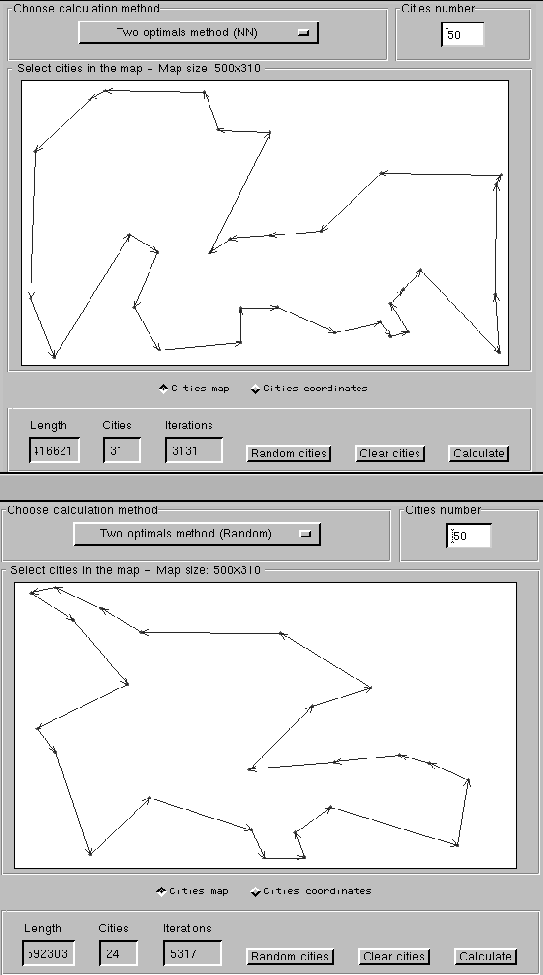
Figures 2.9 show the nearest neighbor and the repeated nearest neighbor examples. The repeated nearest neighbor starts from random starting points. Two optimal is a version of the permutation algorithm described in the section 5.2. Two optimal (random)
uses the results of nearest neighbor algorithm
as the starting path.
.
Figures 2.9 show the nearest neighbor and the repeated nearest neighbor examples. The repeated nearest neighbor starts from random starting points. Two optimal is a version of the permutation algorithm described in the section 5.2. Two optimal (random)
uses the results of nearest neighbor algorithm
as the starting path.
and the  .
Figures 2.11 show the nearest neighbor and the bubble examples. The bubble algorithm is similar to nearest neighbor, however the bubble starts from three connected cities.
.
Figures 2.11 show the nearest neighbor and the bubble examples. The bubble algorithm is similar to nearest neighbor, however the bubble starts from three connected cities.
jonas mockus 2004-03-20