Next: 17 OPTIMAL SCHEDULING Up: 3 EXAMPLES OF MODELS Previous: 15 EXCHANGE RATE PREDICTION Contents Index
One models call centers as queuing systems. The modeling system includes features for call rate predictions and service optimization. One assumes that
 , a call rate is the average number of calls in a
time unit,
, a call rate is the average number of calls in a
time unit,
 servers with the same service rate
 , the service rate is the average number of calls that can
be served in a time unit,
,
, the service rate is the average number of calls that can
be served in a time unit,
,
 , in such a case

 is an average time between the calls and
 is an average service time,
 waiting places,
that means that a call waits, if there are not more than
other calls waiting, otherwise, the call disappears,
and are
constant,
waiting places,
that means that a call waits, if there are not more than
other calls waiting, otherwise, the call disappears,
and are
constant,
 is the server running cost ( $ per time
unit),
is the server running cost ( $ per time
unit),
 is the customer time cost ( $ per time
unit),
is the customer time cost ( $ per time
unit),
 is the lost customer cost ( $ per lost call),
 minimizes the
total cost
minimizes the
total cost 
![[*]](footnote.png) per time unit, including the server running
cost, the customer time cost, and the lost customer cost at
fixed parameters and
per time unit, including the server running
cost, the customer time cost, and the lost customer cost at
fixed parameters and
 ,
,
 , where
 is the probability that the waiting time
  will be
less than
will be
less than  at fixed number of servers and waiting places
,
at fixed number of servers and waiting places
,
 is defined
for different parameters
is defined
for different parameters  , these functions are
presented in a simple format, assuming that the number of servers
is obtained by minimizing the total cost
, these functions are
presented in a simple format, assuming that the number of servers
is obtained by minimizing the total cost  .
.
 calls in the system, including both, waiting calls and calls
in services
calls in the system, including both, waiting calls and calls
in services
 . The no-calls probability

 is
is
 is defined by expression (16.3)
and
is defined by expression (16.3)
and
 . The waiting time distribution
functions
. The waiting time distribution
functions
 denotes the probability that waiting time
will exceed some fixed under condition that there
are calls
denotes the probability that waiting time
will exceed some fixed under condition that there
are calls
 is the probability that
  calls will be served
during the time and
of waiting places is very large, one
considers asymptotic expressions (
calls will be served
during the time and
of waiting places is very large, one
considers asymptotic expressions (
 ) as a reasonable approximation. The asymptotic values are
denoted by the index
) as a reasonable approximation. The asymptotic values are
denoted by the index  . They are used to test
the software designed for finite . The
no-calls probability
. They are used to test
the software designed for finite . The
no-calls probability

 sec. Otherwise, a
call gets a "surrogate" service by voice-mail. For simplicity,
one replaces this service system by a
system with
sec. Otherwise, a
call gets a "surrogate" service by voice-mail. For simplicity,
one replaces this service system by a
system with
 , where the expected service time
is
, where the expected service time
is
 . Then one can use all the expressions for
the queuing system with waiting places.
Here, the call served by voice-mail is considered as the "lost"
call. One considers calls of different type
separately, because they are served by different agents.
directly, if is
limited. Then one uses least square estimates. The square
deviations
. Then one can use all the expressions for
the queuing system with waiting places.
Here, the call served by voice-mail is considered as the "lost"
call. One considers calls of different type
separately, because they are served by different agents.
directly, if is
limited. Then one uses least square estimates. The square
deviations
 between stationary
probabilities
between stationary
probabilities
 and their estimates
  are minimized.
calls in the
system are defined by expression
are obtained by counting the numbers of
waiting calls at different time moments. Additional errors are
expected, if the average number of waiting calls in a time unit is counted, instead of moment numbers.
are minimized.
calls in the
system are defined by expression
are obtained by counting the numbers of
waiting calls at different time moments. Additional errors are
expected, if the average number of waiting calls in a time unit is counted, instead of moment numbers.
by simple
comparison of different within reasonable bounds

, and/or the service rate
depends on time. That often happens in real service systems.
The configuration and operating rules of real service systems
are too complicated for the exact solution, as usual.
Then the Monte Carlo Simulation (MCS) is needed. We start the discussion of MCS from the steady-state systems keeping all the assumptions described in Section 1.2. That helps to test both the analytical and the Monte Carlo solutions by comparing the results. Later, MCS is extended to more complicated configurations and to time-dependent cases.
Denote by
 the distribution function, where
 is the probability that a random time
will be less then . Here
is the probability that a random time
will be less then . Here  is the expected value of .
Denote by
is the expected value of .
Denote by ![$\xi \in [0,1]$](img85.gif) the random variable uniformly
distributed between zero and one. Then
the random variable uniformly
distributed between zero and one. Then
 , if times until the next call are generated.
 , if service times are generated.
Here is a description of an algorithm of modeling and optimization of call centers:
 the "arriving" time of the
  th call, then
 , where
  is a random number, uniform in
![$[0,1]$](img129.gif) , and is the average number of calls in a time
unit, the moment of the first call moment
, and is the average number of calls in a time
unit, the moment of the first call moment  is the start
of MCS,
is the start
of MCS,
 the "departing" time of th
call, then
the "departing" time of th
call, then
 , where
  is the average number of
calls which can be served in a time unit by all
is the average number of
calls which can be served in a time unit by all
 servers operating at the moment , thus
 , and is the average number of calls, served by single
server in a unit time,
, and is the average number of calls, served by single
server in a unit time,
 including those in servers and
waiting places by this expression
including those in servers and
waiting places by this expression
 is the number of calls in the system at the moment
,
is the number of calls in the system at the moment
,
 operating at
the moment by this condition
operating at
the moment by this condition
 by the
expression
by the
expression
 is the number of calls lost up to the the moment
,
is the number of calls lost up to the the moment
,
 that waited less than
 that
waited less than
by simple
comparison of different within some reasonable bounds
that
waited less than
by simple
comparison of different within some reasonable bounds

 of the results
  of a statistical model
depends on the number of observations
of a statistical model
depends on the number of observations  as
as

 is the "initial" standard deviation

 and
and  is the expectation symbol.
In Monte Carlo simulation,  cannot be estimated
directly using the results
cannot be estimated
directly using the results  obtained by the 1-th
observation. Many observations are needed, to reach a stationary
state (one observation means one call). Therefore, we repeat the
Monte Carlo simulation
obtained by the 1-th
observation. Many observations are needed, to reach a stationary
state (one observation means one call). Therefore, we repeat the
Monte Carlo simulation  times doing observations each
time. Then the error variance can be estimated as
times doing observations each
time. Then the error variance can be estimated as
 is known . Then
 satisfying this inequality:

 is a standard deviation of call rate predictions.
 . Different calls are served
by different servers. However, there are
. Different calls are served
by different servers. However, there are  of common
waiting places. There are no simple formulas, such as
(16.16) and (16.15). Therefore, we consider
two approximate solutions: the analytical
"reservation" model, and the Monte Carlo one.
of common
waiting places. There are no simple formulas, such as
(16.16) and (16.15). Therefore, we consider
two approximate solutions: the analytical
"reservation" model, and the Monte Carlo one.
by minimizing
the square deviations
 is the stationary
probability that there are
is the stationary
probability that there are  calls in the -th server. This
probability is defined by expressions similar to (16.3),
assuming that there are
calls in the -th server. This
probability is defined by expressions similar to (16.3),
assuming that there are  waiting places reserved for the
calls
waiting places reserved for the
calls  .
.
 is the reservation vector
and
is the reservation vector
and
 .
.

 are obtained by counting the numbers
of waiting -calls at different time moments. The least
square estimate of the call-vector is as follows
are obtained by counting the numbers
of waiting -calls at different time moments. The least
square estimate of the call-vector is as follows
in the same way as the analytical one. One estimates
by minimizing the square
deviations
 between the probabilities
and their estimates
between the probabilities
and their estimates
 is the
probabilitythat there are calls in the -th server. The estimates are
obtained by counting the numbers of waiting -calls at
different time moments.
is the
probabilitythat there are calls in the -th server. The estimates are
obtained by counting the numbers of waiting -calls at
different time moments.
The least squares estimate of the
call-vector
To test analytical approximation, one compares
estimates of call rates
obtained by both the statistical and the reservation models. A
small deviation means that the reservation model is acceptable.
The large deviation means that the analytical approximation
should be improved.
 ,
the number of servers
,
the number of servers  , and the number of waiting
places
, and the number of waiting
places  depend on time. Therefore, all the results
should be represented as functions of time. One modifies
algorithms, similar to those in the previous chapter, by
including the time factor:
the "arriving" time of the th call, then
depend on time. Therefore, all the results
should be represented as functions of time. One modifies
algorithms, similar to those in the previous chapter, by
including the time factor:
the "arriving" time of the th call, then
 , where is a random number uniform in
and is the average number of calls arriving in a time
unit that includes the moment ,
the
"departing" time of th call, then
where is the average number of calls
which can be served in a time unit by all the
, where is a random number uniform in
and is the average number of calls arriving in a time
unit that includes the moment ,
the
"departing" time of th call, then
where is the average number of calls
which can be served in a time unit by all the
 servers operating at the moment , thus
and is the average number of calls served by
single server in unit time,
, including those in
servers operating at the moment , thus
and is the average number of calls served by
single server in unit time,
, including those in
 servers and
  waiting places
 is the number of calls in the system at the moment
,
operating at the
moment
is the number of calls in the system at the moment
,
operating at the
moment

 is the number of calls lost up to the the moment
,
that waited less than
is the number of calls lost up to the the moment
,
that waited less than
 that
waited less than
that
waited less than
 at different times
by solving the corresponding stochastic scheduling
problem
, where
is the
probability that the waiting time will be less than ,
at different times
by solving the corresponding stochastic scheduling
problem
, where
is the
probability that the waiting time will be less than ,
 by Monte Carlo
experimentation.
by Monte Carlo
experimentation.
 and
and  . is caunted in
hours. is average number of calls in 24 hours.
. is caunted in
hours. is average number of calls in 24 hours.  is
amplitude of daily variation of calls,
is
amplitude of daily variation of calls,  .
.
 and
and  of two different
servers considering two periods. This is a short description of
the optimization problem:
and
restricted by bounds
of two different
servers considering two periods. This is a short description of
the optimization problem:
and
restricted by bounds
 and
and
 ,
,
 |
The results show that one does not improve predictions by
including the external factors directly into the ARMA model. A reason is that in the ARMA
framework it is difficult to estimate the delay time (see
expression (15.22)) and the duration of impacts Special
Events (SE). The additional
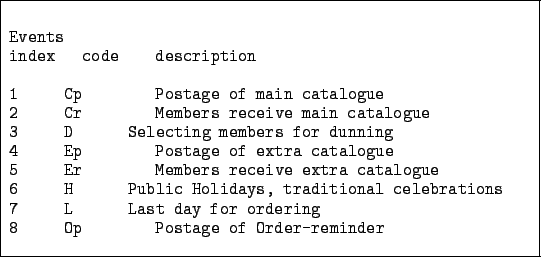
difficulty is that most of SE are rare (see Figure
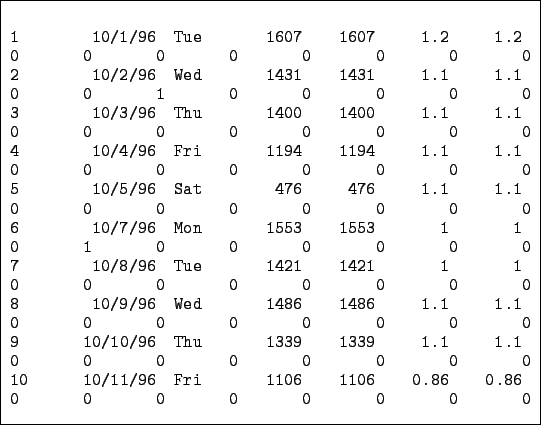
16.1). Therefore, columns of date file are filled
mostly by zeros. Most of the SE indicated in Figure
16.2 are predictable. For example, one can predict
factor 6 ( public holidays, traditional celebrations) and factor
7 (last day for ordering) exactly. Other SE can be predicted
approximately. The knowledge of future values of external
factors helps to predict the main one. However, the present software
version cannot use this possibility yet.
Here, we
consider call rates  as a sum of two stochastic
functions
as a sum of two stochastic
functions
has several components
 corresponding to
different types of calls. In expression (16.48)
corresponding to
different types of calls. In expression (16.48)
 denotes a "stationary" component which is described by
the ARMA model. A "non-stationary" component is denoted by
denotes a "stationary" component which is described by
the ARMA model. A "non-stationary" component is denoted by
 . This way we separate the stationary part from the
non-stationary one.
. This way we separate the stationary part from the
non-stationary one.
The theoretical analysis of
non-stationary stochastic functions is difficult. Therefore, the
separation of non-stationary component is important. The
non-stationary component is defined by a local expert, as usual.
The expert applies his knowledge while using the previous data
and making the future predictions. Thus, we call as the
"expert" component and as the "statistical" one. The
estimate of the statistical component is investigated in
Chapter 15, considering the ARMA model. An alternative is "Scale" models. They predict the expert component
by estimated scales. The scales express the
differences between different SE and different times.
 are eliminated. The estimates of
the remaining ones are obtained. Therefore, one may regard ARMA
parameters as some scales, too. These scales reflect the
influence of the corresponding data sets by minimization of
prediction errors. No expert knowledge is involved.
are eliminated. The estimates of
the remaining ones are obtained. Therefore, one may regard ARMA
parameters as some scales, too. These scales reflect the
influence of the corresponding data sets by minimization of
prediction errors. No expert knowledge is involved.
Now we shall consider the scale models, where the expert opinion is involved. This is done by choosing data sets and scales reflecting the expert opinion. Two versions of scales models are considered.
In the first model it is supposed that the
prediction  is a product of the present call rate
  and some scale
is a predicted call rate, called a "prediction."
is an observed call rate, called a "data set." The
index  defines the data set used to predict . The
parameter is the "scale" to predict by
the data set . Expression (16.49) is a time
scale model. In this model the scale is estimated as
defines the data set used to predict . The
parameter is the "scale" to predict by
the data set . Expression (16.49) is a time
scale model. In this model the scale is estimated as
 defines a period
which precedes
defines a period
which precedes  . The subscript
  denotes a period
preceding . The term "preceding" means the nearest previous
period of the same type. For example, Saturdays, Sundays,
holidays, Christmas weeks, sporting events, days of marketing
messages, e.t.c., all are different types.
denotes a period
preceding . The term "preceding" means the nearest previous
period of the same type. For example, Saturdays, Sundays,
holidays, Christmas weeks, sporting events, days of marketing
messages, e.t.c., all are different types.
In the second model
In
the vector case, expressions (16.49) and (16.51)
predict different call rate graphs. One represents these graphs
as vectors
 . The components
  denote call rates of different parts
  of a period For
example, hours if we predict next day call rates.
of a period For
example, hours if we predict next day call rates.
The
assumption of the first model (16.49) is that the next
day graph
is equal to the present one
 multiplied by scales
 denotes the average call rates
of the period . Expression (16.53) means that
the shapes of the next and the present graphs remains the
same. Only the scales differ.
denotes the average call rates
of the period . Expression (16.53) means that
the shapes of the next and the present graphs remains the
same. Only the scales differ.
The second model
(16.51) assumes that the next day graph is equal to the
graph of the preceding period
 multiplied by scales
 of scales of the first model depends on the
Special Events (SE) of the next period .
We call the first
model (16.49) as the event scale model.
of scales of the first model depends on the
Special Events (SE) of the next period .
We call the first
model (16.49) as the event scale model.
The numerator of scales of the
first model depends on the Special Events (SE) of the next
period . By definition, the preceding period depends
on the type of next one. The period type is defined by the
Special Event (SE) which is active in the period. Examples of
SE are Saturdays, Sundays, holidays, Christmas weeks, sporting
events, days of marketing messages e.t.c..
The numerator
 of scales
  of the second model depends on
the average call rate now . Therefore, we call the second
model (16.51) as the time scale model.
of the second model depends on
the average call rate now . Therefore, we call the second
model (16.51) as the time scale model.
Using the event scale model (16.49), the next day event SE defines the next day scale. The shape of the next day graph remains the same as today. Therefore, this model reflects the changes of the graph shapes without delay.
Using the time scale model (16.51), the shape of the next day graph is the same as the shape of the preceding one. Here the graph changes, but with some delay. The interval between the next period and the previous period of the same type defines the delay time.
. The scale depends on the Special Event (SE) which
is expected to be active in the next period. The periods where
no special events are active, we consider as periods with
"neutral" special events. Scales determine the impact of
SE to the call rate of next period.
The scale
reflecting the impact of a special event is estimated
using empirical data by expressions (16.50),
(16.53) and/or directly by expert opinions.
The
impact of some special events, such as Saturdays, Sundays,
holidays, Christmas week e.t.c.. is well defined and instant. One calls them Instant Special Events (ISE).
The impact
of some others, such as marketing messages, is delayed. Call
rates react to these events with some delay. Therefore, one calls them
Delay Special Events (DSE). The starts and the durations of
DSE are fixed. The delay times  and the durations of
DSE impacts are estimated using the observed data and expert
knowledge. In some periods several DSE may be active
simultaneously. One calls these Multiple Special
Event (MSE).
and the durations of
DSE impacts are estimated using the observed data and expert
knowledge. In some periods several DSE may be active
simultaneously. One calls these Multiple Special
Event (MSE).
The starts and the durations of ISE and
their impacts are equal to starts and durations of the corresponding
periods. Beginnings and durations of DSE impacts are not
necessarily equal to the beginnings and durations of the periods.
Therefore, a special sorts of DSE appear, called Partial Special
Events (PSE). In PSE the impact of a special event is active
only during some part of the period. The delay times , the
durations of the impacts of DSE, and the scales
defining the impact of all the special events, are estimated using
the available data and the expert knowledge.
.
The first procedure is the empirical one. The
scales describing the impact of all sorts of events,
including the partial and the multiple ones, are estimated by
expressions (16.50) or (16.53). These
expressions define the relation of the call rates in the pair
of periods and . A period precedes
the present period . Denote by a period that
precedes the next one, denoted . The numerator  is the call
rate of the period preceding the next one. The
denominator
is the call
rate of the period preceding the next one. The
denominator  is the call rate of the period
preceding the present one.
is the call rate of the period
preceding the present one.
Using the empirical
procedure, partial and multiple special events are considered
as different SE. Here scales are defined separately for
each of them. Therefore, the empirical procedure is convenient,
if the data is available for all types of periods, including the
partial and multiple ones. In such a case, estimate of the
delays and durations of DSE is not needed. It is
supposed that an identical situationis in the available data. One needs large data sets for that.
The second direct procedure is the subjective one. All
unknown parameters of the expert model, such as the scales ,
the delay times and the duration times , are defined
by the expert opinion. This is a reasonable way to start a new
system, when no data is available.
The third direct
procedure is a mixture of the empirical and the subjective ones.
We use empirical estimates, if the corresponding data is
available. Otherwise, one
uses subjective estimates. Using the method of least
squares, we search for such scales , such delay and duration
times  that minimize the sum of squared deviations. The
deviations are differences between the call rates predicted by
the expert model and the observed call rates .
All four procedures are applied to different times: hours, days,
weeks and seasons. First, we consider the scalar case.
that minimize the sum of squared deviations. The
deviations are differences between the call rates predicted by
the expert model and the observed call rates .
All four procedures are applied to different times: hours, days,
weeks and seasons. First, we consider the scalar case.
as a sample of some non-stationary
stochastic process. Four different periods; hours, days, weeks,
and seasons, are considered independently. Let us start by
describing hours.
of the next
hour is expressed this way
is the present call rate. is a scale of the
next hour . The hourly scales differ depending on the
impact of SE felt at the day . For example, working days,
weekends, Christmas days, marketing messages days, e.t.c.
is a subscript of the hour preceding the next
one. is a subscript of the hour preceding the
present one. Following examples illustrate what one means by
the term "preceding."
, that is the second one of a working day. Assume that the
present hour is the first one of a working day. Then
is the subscript of the most recent previous second
hour of a working day with the same impact SE. is the
subscript of the most recent previous first hour of a working
day with no SE. In this example, we consider a multiple SE as two
single SE. The first single SE means the first working hour
without the impact of marketing messages. The second single SE
defines the second working hour with the impact of marketing
messages.
Another way is to consider the impacts of those
two SE separately. Then one defines the scale as a product
of two scales
 is the index of the first hour and
  is the index of the second hour. Both indices denote the previous
working day.
is the index of the second hour. Both indices denote the previous
working day.
 is the index of the most recent hour with
"marketing" and is the index the most recent hour with no
"marketing." Expression (16.58) needs less data.
However, it is based on the assumption that scales are
multiplicative. Expression (16.58) involves expert
opinion by assuming multiplicativity of scales. Expression (16.57) is an example of
empirical approach; multiple SE are considered as different
special events.
is the index of the most recent hour with
"marketing" and is the index the most recent hour with no
"marketing." Expression (16.58) needs less data.
However, it is based on the assumption that scales are
multiplicative. Expression (16.58) involves expert
opinion by assuming multiplicativity of scales. Expression (16.57) is an example of
empirical approach; multiple SE are considered as different
special events.
. Supose that PSE is a special sort of SE with the
scale
is the subscript of the most recent previous day
when the "marketing" starts at the 20-th minute of second
working hour. is the subscript of the most recent
previous first hour of a working day with no marketing.
Another way is to consider the impact of PSE by setting the
scale of marketing messages, in proportion to the duration
of their impact
is the subscript of the most recent previous day
when the "marketing" starts at the second working hour.
is the subscript of the most recent previous first hour
of a working day with no marketing.
Expression (16.62) needs less data. However, it is based on the assumption that scales are proportional to the impact duration. Expression (16.62) involves expert opinion by assuming the proportionality of scales. Expression (16.61) is an example of the empirical approach where a PSE is considered as a different special event.
 the call rate prediction by an
expert model with fixed parameters
the call rate prediction by an
expert model with fixed parameters  . One predicts call
rates of the next period , using data up to the period .
The parameters of the model include scales and delay and
duration times
. One predicts call
rates of the next period , using data up to the period .
The parameters of the model include scales and delay and
duration times  . We minimize the sum
 is the end and
  is the beginning of the "learning"
set.
is the beginning of the "learning"
set.
One minimizes (16.64) by
various global and local optimization methods. That means that
estimates of parameters of expert scale models are obtained in
the same way as estimates of ARMA parameters (see Section
15). The difference of (16.64), is that parameters of the
expert model EM are optimized, instead of ARMA parameters . The optimization problem (16.64)
is very difficult. Here, the number of variables is great and
the objective function is multi-modal.
.
The only
difference from the scalar prediction is that we predict not a
single call rate of the next period , but some vector
. Here the component
definines the call rate of the part of the period .
First, we consider daily predictions, where index denotes
days and the index denotes hours.
of the hour of the day is
 is the call rate of the hour of the present
day .
is the call rate of the hour of the present
day .  is a scale of the next day . The scales
depend on the impact of SE felt at the day . For
example, working day, Saturday, Sunday, Christmas day,
marketing day, e.t.c.
the subscript of the nearest previous day,
similar to the next one. Denote by the subscript of
the nearest previous day, similar to the present one. The
meaning of "nearest previous day similar to" is illustrated by
following examples.
is a scale of the next day . The scales
depend on the impact of SE felt at the day . For
example, working day, Saturday, Sunday, Christmas day,
marketing day, e.t.c.
the subscript of the nearest previous day,
similar to the next one. Denote by the subscript of
the nearest previous day, similar to the present one. The
meaning of "nearest previous day similar to" is illustrated by
following examples.
. That is Tuesday. The present day
is Monday with no additional special events. Then the scale
is the subscript of the most recent previous Tuesday
with the same SE. is the subscript of the most recent
previous Monday with no SE. In this example we considered a
multiple SE as two single SE: Monday without marketing, and
Tuesday with marketing.
Another way is to consider the
impacts of those two SE by defining the scale as a product
of two scales.
is the index of Monday, is the index
of Tuesday of the previous week, and
is the index of the most recent day with
"marketing." Index denotes the most recent day with
no "marketing." Expression (16.67) is an example of
empirical approach. Here multiple SE are regarded as different
special events. Expression (16.68) needs less data but
is based on an expert assumption that scales are multiplicative.
on the sixth working hour. That is the only
difference from the previous example. Let us to consider PSE as
another SE. Then
is the subscript of the most recent previous week
when the "marketing" starts Tuesday at the sixth working hour.
is the subscript of the most recent previous Monday with
no marketing.
Another way is to regard PSE as a reduced
SE. Then, the scale is proportional to the impact duration
is the subscript of the most recent previous week, such
that "marketing" starts Tuesday on the sixth hour, and
is the subscript of the most recent previous Monday with
no marketing.
Expression (16.71) is an example of empirical approach when a PSE is regarded as a different special event. Expression (16.72) needs less data. However, it is based on an expert assumption that scales are proportional to the impact duration.
 the call rate prediction by an
expert model with fixed parameters . One predicts call
rates of the part of the next period using data up to the
period . The parameters of the expert model include scales
and delay and duration times . All special events,
including DSE and PSE, are regarded. We minimize the sum
is the end and is the beginning of the "learning"
set.
the call rate prediction by an
expert model with fixed parameters . One predicts call
rates of the part of the next period using data up to the
period . The parameters of the expert model include scales
and delay and duration times . All special events,
including DSE and PSE, are regarded. We minimize the sum
is the end and is the beginning of the "learning"
set.
Define the expression (16.74) as a function 'fi' in the file 'fi.C'. Then one minimizes (16.74) by various global and local optimization methods. That means that estimates of parameters of expert scale models are obtained in the same way as estimates of ARMA parameters (see Section 15).
 of the
next day graph remains the same as that on the preceding day
. Only scales
of the
next day graph remains the same as that on the preceding day
. Only scales  change. This
follows from (16.52). Scales of the
present period reflect changes of average call rates
between the present period and the preceding one. The scales are
estimated using empirical data and/or expert opinion. The
definitions and examples of all the special events are the same
as in the Event Scale case (see Section 10.3).
. Here
means the call rate of the part of the period . First, we
consider daily predictions. Then the index denotes days, and the
index denotes hours.
change. This
follows from (16.52). Scales of the
present period reflect changes of average call rates
between the present period and the preceding one. The scales are
estimated using empirical data and/or expert opinion. The
definitions and examples of all the special events are the same
as in the Event Scale case (see Section 10.3).
. Here
means the call rate of the part of the period . First, we
consider daily predictions. Then the index denotes days, and the
index denotes hours.
of the hour of the next day is
 is the call rate of the hour of the day
preceding the next one. is a scale of today .
Scales depend on the impact of SE felt at the day
. For example, working day, Saturday, Sunday, Christmas day,
marketing day, e.t.c.
is a subscript of the day preceding the present
one. The term "preceding" is illustrated by the following
examples.
is the call rate of the hour of the day
preceding the next one. is a scale of today .
Scales depend on the impact of SE felt at the day
. For example, working day, Saturday, Sunday, Christmas day,
marketing day, e.t.c.
is a subscript of the day preceding the present
one. The term "preceding" is illustrated by the following
examples.
, which is Monday. The next day is
Tuesday with no additional special events. Then the scale
denotes the day, which precedes the present
one. Here, we regard a multiple SE as two single SE. First
single SE is Monday with marketing. The second single SE is
Tuesday without marketing.
Another way is to regard the
impacts of those two SE by defining a scale as a
product of two scales.
is the index of the day preceding Monday without
marketing.  is the index of the day preceding
.
is the index of the day preceding
.
 is the index of the day preceding the day with
marketing.
is the index of the day preceding the day with
marketing.  is the index of the day preceding
.
is the index of the day preceding
.
Expression (16.77) is an example of empirical approach when multiple SE are regarded as different special events. Expression (16.78) needs less data but is based on the assumption that scales are multiplicative.
. Regarding PSE as another
SE the scale is
is the index of the day preceding the present one.
Another way is to regard the PSE as a reduced SE. Then
the scale is proportional to the impact duration
 is the index of the preceding marketing Monday.
 is the index of the day preceding .
Applying expression (16.82) one requires less data.
However, this expression is based on the assumption that scales
are proportional to the impact duration.
is the index of the day preceding .
Applying expression (16.82) one requires less data.
However, this expression is based on the assumption that scales
are proportional to the impact duration.
Expression (16.82) involves expert opinion indirectly, by assuming proportional scales. Expression (16.81) is an example of empirical approach when a PSE is regarded as another SE.
the call rate prediction by an
expert model with fixed parameters . One predicts call
rates of the part of the next period using data up to the
period . The parameters of the expert model include scales
and delay and duration times . All special events,
including DSE and PSE are regarded. We minimize the sum
is the end and is the beginning of the "learning"
set.
One minimizes (16.64) by
corresponding global and local optimization methods.
cannot be defined directly. Then their estimates are used (see
Section 5). Missing or uncertain data is
replaced by expert estimates. This is important for the first
year of operation.
 of the expert scale model
, where
of the expert scale model
, where
 [Mockus et al., 1997]. The formal description of the ARMA model is in
Chapter 15. The software is on the web-site (see
Section 4).
If predicting we do not know
some values of
[Mockus et al., 1997]. The formal description of the ARMA model is in
Chapter 15. The software is on the web-site (see
Section 4).
If predicting we do not know
some values of
 then we replace the
missing data by the expected values of the unknown
then we replace the
missing data by the expected values of the unknown  defined recurrently (see Section 10).
ARMA models predict only the difference between the expert
models (EM) and the data. Therefore, in the first step, EM
models are adapted to the data by defining the right scales. Only
then, the parameters  of ARMA models are optimized. This
means that one minimizes a squared difference between the adapted
EM model and the observed data. Predicting the data, the results
of both EM and AH models are summed up.
of ARMA models are optimized. This
means that one minimizes a squared difference between the adapted
EM model and the observed data. Predicting the data, the results
of both EM and AH models are summed up.
is performed using
multi-step ARMA predictions described in Section 10
"Confidence cones" could be useful for preliminary evaluation of
prediction errors. They estimate probable deviations from
expected values with some "confidence level," say ninety percent or
ninety nine percent. These cones are defined empirically as upper and
lower limits of the results obtained by repetition of Monte
Carlo procedures (see Section 10).

 by minimizing the
sum of squared deviations. The deviations are differences
between results of approximate single-skill model and the
multi-skill one
by minimizing the
sum of squared deviations. The deviations are differences
between results of approximate single-skill model and the
multi-skill one

 denotes the results of the iteration of a Monte
Carlo simulation of the multi-skill system. is the call
rate.
denotes the results of the iteration of a Monte
Carlo simulation of the multi-skill system. is the call
rate.  is the number of multi-skill agents.
  is the
result of the iteration of a Monte Carlo simulation of a
single-skill system.
is the
result of the iteration of a Monte Carlo simulation of a
single-skill system.  is the number of single-skill
agents, which replace the multi-skill ones.
is the number of single-skill
agents, which replace the multi-skill ones.
Another way
is to extend the single-skill simulation (see Section
11) to the multi-skill case. Here one needs more
computing time to estimate the "optimal" weights for
different call rates. For example, the method  is used
to obtain the best values of (see Section 4).
is used
to obtain the best values of (see Section 4).
 ,
the C++ version is denoted by
,
the C++ version is denoted by  .
.
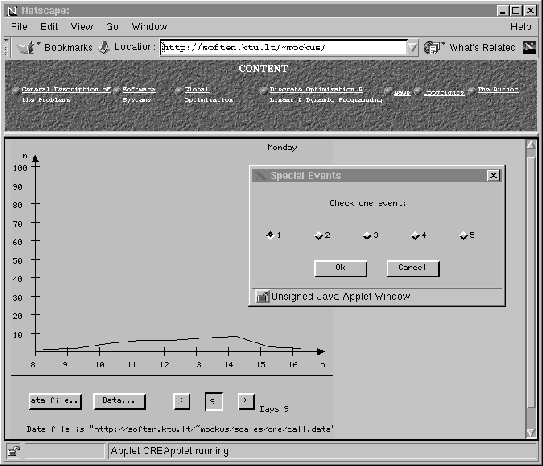
To start the program [Jankauskas, 2000], one goes to one of web-sites (see Section 4) and selects the problem "Call Center-SCALES-GMJ" in the section "Global Optimization ". Figure 16.3 shows the operating page.
Here is an illustrative example of data file.