Next: 15 EXCHANGE RATE PREDICTION Up: 3 EXAMPLES OF MODELS Previous: 13 INSPECTION MODEL Contents Index
The portfolio problem is to maximize the average
utility of a wealth. That is obtained by optimal distribution of
available capital between different objects with uncertain
parameters [Mockus et al., 1997]. Denote by  the part of the capital
invested into an object
the part of the capital
invested into an object  . The returned wealth
is
. The returned wealth
is  . Here
 and
and
 is an interest rate. Denote by
  the
reliability of investment. Here
the
reliability of investment. Here  is the insolvency probability.
 is the utility the wealth
  . Denote by
  the expected
utility function. depends on the capital distribution
the expected
utility function. depends on the capital distribution
 . If is continuous,
the expected utility function
. If is continuous,
the expected utility function
 is probability density of wealth . If the wealth is discrete
 , the expected utility function
 is the number of discrete values of wealth
  .
.  is the probability that the wealth will be returned, if the capital
distribution is
is the probability that the wealth will be returned, if the capital
distribution is  . We search for such capital distribution
which provides the greatest expected utility of the returned
wealth:
. We search for such capital distribution
which provides the greatest expected utility of the returned
wealth:
 of discrete values of
wealth
of discrete values of
wealth
 by exact expressions. For example,
 .
From expression (14.5)
is the number of different values of
wealth .
.
From expression (14.5)
is the number of different values of
wealth .
One determines
approximately by the Monte Carlo approach:
 is the number of Monte Carlo samples.
 is a random number uniformly distributed on the unit
interval. In this case
is a random number uniformly distributed on the unit
interval. In this case
 are defined by contracts.
Only the reliabilities
are defined by contracts.
Only the reliabilities
 of banks are uncertain.
Investing in stocks, in addition to reliabilities
of banks are uncertain.
Investing in stocks, in addition to reliabilities
 of companies, their future stock rates are uncertain, too. The predicted stock rates are defined by a coefficient
  that shows the relation between the present and the predicted stock rates. The prediction "horizon" is supposed to be the same as the maturity time of CD.
To simplify the model suppose that one predicts  different values of relative stock rates
 with corresponding estimated probabilities
 .
.
In this case,
one may define probabilities  of discrete values of
wealth
of discrete values of
wealth
 by exact expressions.
The expressions for CD remains the same. Therefore,
we shall consider only stocks assuming that
by exact expressions.
The expressions for CD remains the same. Therefore,
we shall consider only stocks assuming that  and
and  .
Then
.
Then
 .
The reliabilities
.
The reliabilities  , the stock rate predictions
  and their estimated probabilities
  are defined by
experts, possibly, with the help of time series models such as ARMA (see Section 15).
For example, maximal values of multi-step prediction
are considered as "optimistic" estimates. The minimal values- as "pessimistic" ones. The average values of multi-step prediction are regarded as "realistic" estimates.
are defined by
experts, possibly, with the help of time series models such as ARMA (see Section 15).
For example, maximal values of multi-step prediction
are considered as "optimistic" estimates. The minimal values- as "pessimistic" ones. The average values of multi-step prediction are regarded as "realistic" estimates.
Here is a simplest illustration were  and . In this case from (14.5) (14.10)
the probabilities
and . In this case from (14.5) (14.10)
the probabilities  of wealth returns
 are
are
 .
.
Consider, for example, the optimal portfolio for three different
utility functions.
.
.
Consider, for example, the optimal portfolio for three different
utility functions.
The first utility function is linear
 .
.
The second utility function is for "prudent" persons which averse risk
 is a risk threshold.
 denotes the
maximal return of invested capital (see expression
(14.4)). If
denotes the
maximal return of invested capital (see expression
(14.4)). If
 then, in the
risk-averse case (14.12), an optimal decision is
then, in the
risk-averse case (14.12), an optimal decision is
 . Here one divides the capital equally
between all the objects
. Here one divides the capital equally
between all the objects![[*]](footnote.png) .
.
The third utility function is for "risky" persons. Risky persons are
ready to risk for the great win  .
.
 , if
, if
 .
.
These examples
are abstract. An average person behaves "risky," if
only a small part of his resources is involved. The same person
behaves prudently, if all his wealth is at stake. There is
a point  between areas of risky and prudent behavior. At this point an average person
behaves like the "rich" one. Here is an example
between areas of risky and prudent behavior. At this point an average person
behaves like the "rich" one. Here is an example
is a boundary point between risky and prudent areas.
In this section the optimal insurance is regarded as a special case of optimal investment. Then the expected utility at the end of the next year
is a probability to own next year the wealth ,
 is an utility function of the wealth .

 is the value of the object ,
 denotes insurance charge of the object .
 is insurance policy of the object .
 , if the object survives,
 , if not.
 is a survival probability of the object .
 ,
,
 ,
,
 .
.
are different for different persons
and organizations. An individual utility function is defined by
a lottery
 . Here
  is the
probability to win the best event
is the
probability to win the best event  .
.
 is the
probability to get the worst one
is the
probability to get the worst one  . Denote by
  the "ticket
price" of this lottery. There are two possible decisions:
,
with
probability .
the "ticket
price" of this lottery. There are two possible decisions:
,
with
probability .
 a "hesitation" probability, when one cannot
decide which decision to prefer. One defines the "hesitation"
probability by this condition
a "hesitation" probability, when one cannot
decide which decision to prefer. One defines the "hesitation"
probability by this condition
 denotes the "hesitation." If utilities
  and
and  , the utility of the "ticket" is equal to the hesitation
probability
, the utility of the "ticket" is equal to the hesitation
probability  [Fishburn, 1964].
Suppose, for example, that event is to keep all the investment capital,  , in a safe; no risk, no
profit. Assume that the event means doubling the
capital,
, in a safe; no risk, no
profit. Assume that the event means doubling the
capital,  . The event means losing all the
capital,
. The event means losing all the
capital,  .
.
Denote by  the hesitation probability. Then
 . If
. If  and
and  then the
utility of the capital
then the
utility of the capital  . Here one obtained
capital utilities at three points:
. Here one obtained
capital utilities at three points:  , and .
To define a
reasonable approximation of the utility function , we
need at least two additional points. For example, points  and
and  . One defines the corresponding utilities by the
hesitation probabilities
. One defines the corresponding utilities by the
hesitation probabilities  and
and  . These are
obtained by two hesitation lotteries
. These are
obtained by two hesitation lotteries
![\begin{eqnarray}
L(1.0,0.0,0.5,p(0.5))= \\ \nonumber
[(y=0.5) \approx \{p(0.5)(y=1) +(1-p(0.5))(y= 0) \}] \nonumber
\end{eqnarray}](img1424.gif)
![\begin{eqnarray}
L(2.0,1.0,1.5,p(1.5))=\\ \nonumber
[(y=1.0) \approx \{p(1.5)(y=2.0) +(1-p(1.5))(y=1) \}]. \nonumber
\end{eqnarray}](img1425.gif)
 .
The remaining capital utility values are defined by the linear interpolation
.
The remaining capital utility values are defined by the linear interpolation
The same capital utility function (14.14) could be
used for all customers. Then one defines customer differences by different
border points, namely:
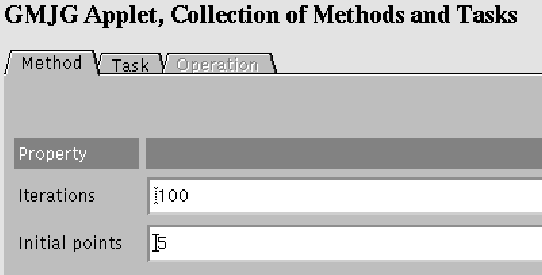
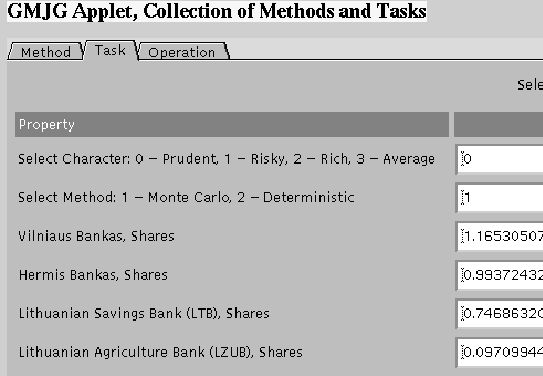
 (see Figure 14.2).
(see Figure 14.3),
.
![$yk[i]=0.25*i,\
i=0,...,8$](img1434.gif) . Four utility functions are available. They
differ at the approximation points.
They represent different persons.
. Four utility functions are available. They
differ at the approximation points.
They represent different persons.
![$f[0]=0.0,\ f[1]=0.3,\ f[2]=0.5,\ f[3]=0.7,\
f[4]=0.8,\ f[5]=0.85,\ f[6]=0.9,\ f[7]=0.95,\ f[8]=1.0$](img1435.gif) ,
,
![$f[0]=0.0,\ f[1]=0.1,\ f[2]=0.2,\ f[3]=0.25,\
f[4]=0.3,\ f[5]=0.4,\ f[6]=0.7,\ f[7]=0.9,\ f[8]=1.0$](img1436.gif) ,
,
![$f[0]=0.0,\ f[1]=0.125,\ f[2]=0.25,\ f[3]=0.325,\
f[4]=0.5,\ f[5]=0.625,\ f[6]=0.75,\ f[7]=0.875,\ f[8]=1.0$](img1437.gif) ,
,
![$f[0]=0.0,\ f[1]=0.1,\ f[2]=0.2,\ f[3]=0.25,\
f[4]=0.5,\ f[5]=0.7,\ f[6]=0.85,\ f[7]=0.95,\ f[8]=1.0$](img1438.gif) .
.
 . Considering shares, only one parameter is
used, the predicted stock rate at the time of CD maturity. That is correct, if
the investor is confident about the predicted stock rates at the maturity time. The default values of
expected changes of stock rates are zero. The predicted stock
rates are given in the files like this one:
. Considering shares, only one parameter is
used, the predicted stock rate at the time of CD maturity. That is correct, if
the investor is confident about the predicted stock rates at the maturity time. The default values of
expected changes of stock rates are zero. The predicted stock
rates are given in the files like this one:
 .
.
Input file = VB.txt
Pradzia = 26.000000 Prognoze = 30.297932 </BODY></HTML>
Here 'VB' denotes the Vilnius Bank stock rates. 'Pradzia' denotes the rates now. 'Prognoze' denotes the predicted rates. The difference between predicted and present stock rates, divided by the present stock rate and expressed in percents, is considered as a "stock interest." That is an important simplification. However, it helps to consider both shares and CD in the same way. That is convenient for calculations.
Predicted rates in  files are
obtained by the ARMA model using the Vilnius Bank data. The predicted
values can be changed manually by clicking and writing on the
corresponding fields of the 'Tasks' page.
files are
obtained by the ARMA model using the Vilnius Bank data. The predicted
values can be changed manually by clicking and writing on the
corresponding fields of the 'Tasks' page.
shows closing rates on January 01, 1998. The
last record defines closing rates on November 14, 1998. Two hundred twenty nine sessions of Lithuanian stock exchange are recorded in the data. Using this
data ARMA model makes ninty day predictions what corresponds to
three month CD.
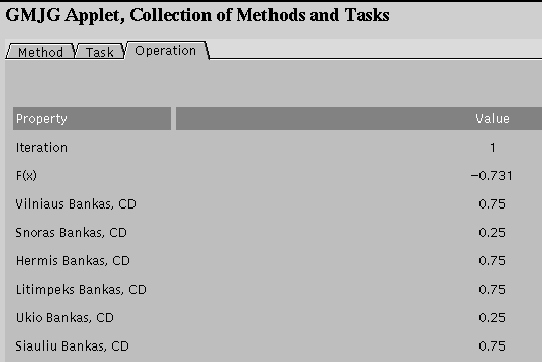
The "Optimal investment" column is just a copy of the output field (see Figure 14.3). The output field represents optimal values of internal variables. The internal variables are proportional to the optimal parts of the capital.
Actual optimal parts are obtained by normalization and are shown
in the "Optimal part" column.
|
|
Tables 14.1 and 14.2
show that the optimal distribution of capital obtained by
the approximate method differ from that defined by the exact one.
This is important disadvantage of
the approximate Monte Carlo method.
Note, that the best values of utility functions are close for both methods. They are
0.773, for the Monte Carlo method, and 0.776, for the deterministic one. This means that the optimal values of utility functions are not very sensitive
to moderate changes in the capital distribution. The reason is
that here investment alternatives are not too different.
|
Comparing Table 14.2 representing the prudent person and Table 14.3 representing the risky one, we see differences. The best value of utility function is equal to 0.776, for the "prudent." It is equal to 0.291, for the "risky." This difference is explained by assumptions made to normalize utility functions. The normalization assumes that the maximal utility is a unit and the minimal one is zero. Therefore, the best value of utility function of the risky person happens to be less then that of the prudent one. However, lower utilities does not mean that risky persons are getting less satisfaction. One needs more sophisticated normalization techniques to compare correctly the satisfaction scales of different persons by their utility functions.
The first step is to drop the "confidence" assumption that one predicts the stock rates exactly. To do this, the variance of the predicted stock rates should be included into the updated Portfolio Model.
The important future task is the sensibility analysis.
For example, by considering three scenarios: pessimistic, optimistic and realistic. In the pessimistic
scenario lower probabilities for CD's and lower interest rates for stocks are considered.
In the optimistic case one sets higher values for these parameters. The realistic case is in the middle. Important task is to represent visually the "stability" of securities .
If the optimal values of some securities are not too different in all three scenarios,
they are considered as stable.
Here we consider an illustrative example
how to invest some fixed capital
to minimize the damages of the road accidents.
The problem is split in two stages.
In the first stage, the resources are distributed between groups of accidents defined by their causes.
In the second stage, the geographical distribution of funds inside a single group is regarded.
The four causes of road accidents are considered:
a part of the funds spent to reduce accidents related to the cause .
In this section, we shall assume for simplicity that the total amount of funds is unit.
Here index  denotes intoxication,
  means speeding,
  denotes safety belts, and
  denotes
black spots.
denotes
black spots.
Denote by
 the expected number of accidents in relation to the part of funds .
Suppose that
the expected number of accidents in relation to the part of funds .
Suppose that
 is the actual number of accidents
when the part of funds was
is the actual number of accidents
when the part of funds was  .
.
Denote the estimate of expected losses from all four groups of accidents
when the distribution of funds between causes are defined by the vector

 is the estimate of expected damages
of an accident of the group .
If data is available, then is just average value.
If not, then is some expert estimate.
is the estimate of expected damages
of an accident of the group .
If data is available, then is just average value.
If not, then is some expert estimate.
The distribution between black spots will be regarded.
Denote the distribution vextor by
 ,
where
,
where  is a number of black spots. is the part of funds invested to improve the black spot .
Denote by
is a number of black spots. is the part of funds invested to improve the black spot .
Denote by
 the expected number of accidents in relation to the part of funds .
is the actual number of accidents
at the black spot when the part of funds was .
The formal definition is
is the estimate of expected damages
of an accident at the black spot .
If data is available, then is just average value.
If not, then is some expert estimate.
The direct minimization of the -dimensional utility
function (14.27) is difficult if is large. In the case (14.27) the dynamic programming is an appropriate optimization technique.
The dynamic programming is a conventional technique to optimize sequential decisions [Bellman, 1957]. Applying the dynamic programming to specific problems, one develops specific algorithms, as usual.
defining by  a part of funds left for the spot .
Then
a part of funds left for the spot .
Then
 shows how the maximal utility that can be obtained if the part of funds designated for the set of black spots starting from
  is distributed in the best possible way. The relation
 shows how the optimal part of funds for
the black spot depends on the part of funds designated for the set of black spots starting from .
Here
shows how the optimal part of funds for
the black spot depends on the part of funds designated for the set of black spots starting from .
Here  .
.
Reurrent equations (14.32) and (14.33)
define the optimal parts of funds as a function of . The actual optimal values of these funds  are obtained by substitutions assuming that the total amount of funds is unit.


![\begin{eqnarray}
y_i^k&=&\cases {c_i x_i, &if $\eta_i^k \in [0,p_i]$\ \cr
0, &otherwise.\cr}
\end{eqnarray}](img1357.gif)


![\begin{eqnarray}
L(A,B,C,p(C))=[C \approx \{p(C) A + (1-p(C)) B\}].
\end{eqnarray}](img1406.gif)