


Next: 14 INVESTMENT PROBLEM Up: 3 EXAMPLES OF MODELS Previous: 12 DIFFERENTIAL GAME Contents Index
The Nash and Walras models illustrate the competition in economics. Both models define such prices and other production parameters that satisfy the Nash equilibrium. However, the market competition represents only a part of economical and social activities. Another part is the inspection that one needs to provide tax collection, health and environment protection, e.t.c.. We consider a simple model that illustrates the competition between inspector and violator.
 where
where  denote moves (pure strategies) of the first player and
  represent moves of the second one.
The payoff of the second player is
represent moves of the second one.
The payoff of the second player is  .
The utility functions
.
The utility functions  and
and  of the first and second
players are defined as expected values of
the payoffs and .
of the first and second
players are defined as expected values of
the payoffs and .
 and
and
 are probabilities (mixed strategies) of moves
  and
and  .
.
In the Bimatrix Game (BG)
 .
In the Quadratic Bimatrix Game (QBG)
.
In the Quadratic Bimatrix Game (QBG)  .
We shall consider mainly QBM because
they are simpler and represent many real games.
.
We shall consider mainly QBM because
they are simpler and represent many real games.
The QBG is Well-defined Quadratic Bimatrix Game (WBG) if it cannot be reduced to a "lesser" game by elimination of a raw or a column. Details are explained by examples.
This game is not well-defined
 is dominated by the first two columns and will not be used
by the second player.
is dominated by the first two columns and will not be used
by the second player.
However this reduced game can be reduced further by eliminating the third raw, too:

 is dominated
by the first two.
That is convenient because solution of QBG is simpler.
Therefore we later call such games as Almost Quadratic
Bimatrix Games (ABG)
is dominated
by the first two.
That is convenient because solution of QBG is simpler.
Therefore we later call such games as Almost Quadratic
Bimatrix Games (ABG)
Here is another example of not well-defined game
is dominated by the first two
but the third raw of is not. Thus the original quadratic
game is reduced to non-quadratic one by eliminating the third column
of .

Now we shall describe two simple game models.
Consider the ranger-poacher game.
Denote by
 the
inspection vector and by
the
inspection vector and by
 the violation vector. Here
  denotes the inspection
probability of
the area .
denotes the inspection
probability of
the area .  means the violation probability in the area . Denote by the inspection
payoff function when the object is inspected and
the object
is violated. Denote by the violation payoff
function when the object is inspected and the
object is
violated. Functions
means the violation probability in the area . Denote by the inspection
payoff function when the object is inspected and
the object
is violated. Denote by the violation payoff
function when the object is inspected and the
object is
violated. Functions  and
and  denote
the inspection and violation utility functions using
inspection and violation vectors
denote
the inspection and violation utility functions using
inspection and violation vectors  . These vectors define probabilities
of inspection and violation.
. These vectors define probabilities
of inspection and violation.
For example,
 is the probability of detecting the violation if it
happens in the area . A number
is the probability of detecting the violation if it
happens in the area . A number  is the probability of
completing the violation
is the probability of
completing the violation![[*]](footnote.png) if violation occurs in
the area and
if violation occurs in
the area and  is the payoff of the completed violation in the area
.
is the payoff of the completed violation in the area
.
Expression (13.5) means that if the violation is completed and
detected then
the inspector premium is equal to the payoff of
violation. Expression
(13.6) shows that if the violation is completed and detected, the
violator payoff is negative. The payoff is positive, if it is
completed and not detected.
The utility functions at given inspection and violation
vectors  and
and 
 , so the inspection model is
a bimatrix game [Forgo et al., 1999].
The matrices (13.3) were defined by (13.5)(13.6) when
, so the inspection model is
a bimatrix game [Forgo et al., 1999].
The matrices (13.3) were defined by (13.5)(13.6) when
 ,
,
 , and
, and
 .
.
Consider a security system protecting some object.
Denote by
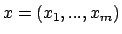 ,
,
 the
protection vector and by
the violation vector. Here denotes the
part of security funds designated to protect
the area and means the violation probability of the area .
Denote by the security
payoff function
when the area is protected
and the area
is violated. Denote by the violation payoff
function when the area is protected and the area is
violated. Utility functions and denote expected values
of security and violation payoff functions using
protection and violation vectors . These vectors define the distribution
of protection funds and
violation probabilities.
the
protection vector and by
the violation vector. Here denotes the
part of security funds designated to protect
the area and means the violation probability of the area .
Denote by the security
payoff function
when the area is protected
and the area
is violated. Denote by the violation payoff
function when the area is protected and the area is
violated. Utility functions and denote expected values
of security and violation payoff functions using
protection and violation vectors . These vectors define the distribution
of protection funds and
violation probabilities.
Consider examples of simplified payoff functions. We start by defining security payoff function
 is the expected reward of security team which protects the area
for preventing the violation and arresting the violators. Denote by
the probability of this event. A number is the value of protected goods.
Denote by the probability of
completing the violation in
the area . Suppose that the expected penalty for bad protection is defined as
the product
is the expected reward of security team which protects the area
for preventing the violation and arresting the violators. Denote by
the probability of this event. A number is the value of protected goods.
Denote by the probability of
completing the violation in
the area . Suppose that the expected penalty for bad protection is defined as
the product
 . The payoff function of security team protecting area
is zero, is no violation happens in this area
. The payoff function of security team protecting area
is zero, is no violation happens in this area  .
.
The violation payoff function
 is the penalty of
attempted
and detected violation where
is the penalty of
attempted
and detected violation where  is a large number.
The expected profit of successful violation of the protected area is defined
as the product
is a large number.
The expected profit of successful violation of the protected area is defined
as the product
 and the expected profit of successful violation of the
unprotected area is
and the expected profit of successful violation of the
unprotected area is  .
.
Assume for simplicity that probability of protection is equal to the part of
security funds . This is the linearizion of the non-linear security function
 .
.
Expression (13.9) means that if the violation is completed and
detected
in the area then
the reward of security is equal to the value of the protected
goods . Expression
(13.10) shows that if the violation is detected, the
violator penalty is a large number .
The violetors payoff is equal to the value of stolen goods if the crime in the area is
successfully completed and not detected.
The utility functions at given inspection and violation
vectors and
.
The matrices (13.4) were defined by (13.9)(13.10) when
,
, and

It is well known [Forgo et al., 1999] that, in randomly generated
large bimatrix games, the proportion of games having  pure
strategy equilibriums is defined by the Poisson distribution
pure
strategy equilibriums is defined by the Poisson distribution
 .
.
 of equilibrium points
in
pure strategies is the intersection of two sets
of equilibrium points
in
pure strategies is the intersection of two sets  and
and  defined by the following conditions
 is a set of maximal elements at each column of
the matrix .
is a set of maximal elements at each column of
the matrix .  is a set of maximal elements at
each row of the matrix . If equilibrium exists and the intersection is
empty, one needs mixed strategies to obtain the
equilibrium [Owen, 1968].
is a set of maximal elements at
each row of the matrix . If equilibrium exists and the intersection is
empty, one needs mixed strategies to obtain the
equilibrium [Owen, 1968].
For a pair  to be an equilibrium point of the
bimatrix game
to be an equilibrium point of the
bimatrix game  , it is necessary and sufficient
[Forgo et al., 1999] that there exist real numbers
, it is necessary and sufficient
[Forgo et al., 1999] that there exist real numbers
 such that
 satisfies the system
denotes the unit vector. The condition (13.18)
represents the bilinear problem because it involves products of
different variables. The solution of bilinear problems is
difficult. Therefore, specific algorithms are developed to search for mixed strategies of
the equilibrium.
Complementary pivoting is most frequently used [Lemke, 1965] one.
The Lemke-Howson algorithm finds a sample equilibrium point of bimatrix
game.
It follows from definition that the mixed strategies and satisfy equilibrium
if one cannot obtain greater profit by changing them.
From conditions
.
Therefore, if the solution of (13.19), (13.21, (13.23)
exists one
obtains the equilibrium just by setting
and
should be expressed as differences of two nonnegative
variables  and
and  . Then from expressions
(13.19) (13.21 (13.23) one obtains this LP problem
. Then from expressions
(13.19) (13.21 (13.23) one obtains this LP problem
 .
.
Note, that in WBG the expressions (13.19) - (13.23) and (13.24) - (13.28) satisfy the equilibrium condition (13.18). That remains true in the almost well-defined quadratic bimatrix games (ABG), too.
The IF conditions shows some interesting aspects of Nash equilibrium of quadratic bimatrix games and can be implemented using standard software for linear equations or linear programming that is simple, efficient and widely available.
 .
Then from (13.5
)(13.6)
.
Then from (13.5
)(13.6)
 from (13.54)


 .
.


 then, in the same way, one obtains


 means a product of all
  except .
Here the solutions
are positive
except .
Here the solutions
are positive
However, the solution of linear inequalities (13.19) - (13.23) and the corresponding LP (13.43) - (13.46) may not exist if the game is not WBG.
Then one searches for the equilibrium using the Direct Search (DS) algorithm (13.14). That complements the IF algorithm (13.44) - (13.46) and defines the equilibrium in pure strategies, if it exists.
 of linear equations (13.19) - (13.22), including
inequalities (13.23),
of linear equations (13.19) - (13.37), ignoring
inequalities (13.23)
of linear equations (13.19) - (13.22), including
inequalities (13.23),
of linear equations (13.19) - (13.37), ignoring
inequalities (13.23)
 and the raw
  if at least one of the
corresponding variables is
negative
if at least one of the
corresponding variables is
negative  or/and
  ,
set to zero both the variables
,
set to zero both the variables  and
and 
 obtainable assuming
that partners keep solutions
obtainable assuming
that partners keep solutions
 with the maximal ones
,
with the maximal ones
,
 and
and
 stop, and record the components
 as equilibrium strategies,
Often the equilibrium is found in NBG, too, but there is no guarantee. However QSE is fast and each solution is tested by conditions (13.69) and (13.70). Therefore one may safely use QSE for NBG as well.
 ,
,
 and
.
and
.


 . Then

 and the expected values
 satisfy the equilibrium conditions as expected because this is ABG.
,
and
.

 . Then


The game will not be played by rules if the players may win more
by breaking them. Unauthorized deals (for example, bribes) are usual tools breaking the rules of non-zero-sum games where
 .
An example of such deal is sharing the killed pray between the inspector and violator.
Values of the optimal deal
.
An example of such deal is sharing the killed pray between the inspector and violator.
Values of the optimal deal
 are defined by the Nash bargaining conditions [Owen, 1968]
The optimal deal
depends on the set of feasible deals  ,
,
and on max-min values defining what the players will get if the deal fails
 is the maximal expected guarantee win of the first player,
 is that of the second player.
 , the second one obtains
  .
.
 is uniquely defined by the following assumptions.
 ,
,
 ,
,
 and
and
 ,
,
 ,
,
 and
, then
and
, then
 ,
,
 is obtained from by this transformation
 ,
then from
,
then from
 follows that
 ,
,
 ,
,
 and
,
then
and
,
then
 .
, such that
.
, such that
 , then the optimal deal

 then
then

 that makes the deal
unprofitable
that makes the deal
unprofitable
 is the maximal expected utility to be divided between the bargaining players.
 .
.
 .
.
 .
From (13.87) expected penalties preventing the deal
.
From (13.87) expected penalties preventing the deal

 . One reduces utilities (13.5) and (13.6) to the zero-sum case by
subtracting the penalty terms
and
. One reduces utilities (13.5) and (13.6) to the zero-sum case by
subtracting the penalty terms
and  from the inspectors utilities. In such a case
 . Here one obtains the equilibrium by solving
two linear programming problems
[Owen, 1968]
. Here one obtains the equilibrium by solving
two linear programming problems
[Owen, 1968]
An interactive QBG model is implemented using Java JDK1.2 [Vaisnora, 2001].
To start the program , one goes to one of web-sites
(see Section 4) and selects
"Discrete Optimization
Bimatrix Game Problem
Bimatrix Game, an example of bimatrix game optimization using LP,
Java 1.3 and DS and QSE algorithms"
The applet starts by clicking 'index.html'. That is not secure mode thus
all the data is introduced just by screen writing.
Starting by the command line:
'appletviewer -J-Djava.security.policy=java.policy index.html'
one works in secure mode and the data can be introduced by files,
for example:
'environment.txt'
#Wed Feb 18 18:01:29 EET 2004
V_EQUTION=-Pi*10+(1-Pi)*Qj*Gj;i\=j;\nQj*Gj;
U_EQUTION=Pi*Gi-(1-Pi)Gi*Qi;i\=j;\n0;\\
DATA_SAVE_URL=file\:/home/jonas/bimatrix/data1.txt
DATA_LOAD_URL=file\:/home/jonas/bimatrix/data-1.txt
VARIABLES=P G Q
RESULTS_SAVE_URL=
and
P   G    Q
0.1 1.0  0.1
0.2 1.0  0.1
0.3 1.0  0.01
Figure 13.1 shows the input window i 2.4 and 2.4.
Figure 13.2 shows the input window defining the payoff functions of security game (13.9) (13.10)
Figure 13.3 shows the input window including data from the security game examples examples 2.4 and 2.4.
Figure 13.4 shows results obtained by solving IF equations (13.19 - (13.22) ignoring constrains (13.23
Figure 13.5 shows the input data for the reduced QBG obtained by eliminating the last raw and column.
Figure 13.6 shows the IF solution of the reduced QBG
Figure 13.7 shows the snapshot of the calculations
Data is recorded by adding forests and by entering their parameters  .
To prevent unauthorized deals one enters 'Fine' and 'Fine's probability' defining
the average penalties.
The optimization starts by clicking the button
.
To prevent unauthorized deals one enters 'Fine' and 'Fine's probability' defining
the average penalties.
The optimization starts by clicking the button  .
.
The output window shows average wins in the form of
matrices u[i,j] and v[i,j].
The results of DSA are presented as pairs of
pure strategies, ignoring zero ones,
no DSA solution is found,
The results of IFA shows that there is no IFA solution,
since there are negative parameters, namely  .
.
Following QSE the third raw and the third column are eliminated and the QSE
solution of the reduced QBG
 is found.
The utility functions (13.5)(13.6) of both examples are selected to make models easy understandable without any special knowledge. That is important for studies. Most real life applications are described by more complicated utility functions. Therefore, the natural next step is to implement and to investigate these functions.
Statistical estimation of failures applying QSE algorithm for equilibrium search in the not well-defined cases could be useful because QSE is simple and the test by conditions (13.69) (13.70) is easy.
Optimization of resources preventing unauthorized deals (see section 2.5). is a challenging theoretical and practical problem,too.
jonas mockus 2004-03-20


