


Next: 12 DIFFERENTIAL GAME Up: 3 EXAMPLES OF MODELS Previous: 10 NASH EQUILIBRIUM Contents Index
In the model called by the Nash name, the cost of a service
capacity unit is supposed to be fixed. Each individual server
 controls the capacity
  and the price
  charged for
services. Therefore, the Nash model illustrates the formation of
competitive service prices, if the resource prices are fixed by
some large external market.
charged for
services. Therefore, the Nash model illustrates the formation of
competitive service prices, if the resource prices are fixed by
some large external market.
More complicated models, called by the Walras name, describe the
formation of the competitive resource prices, too. In the Walras
model,
the capacity  of servers
  depends on the
resource vector
depends on the
resource vector
 defining the
consumption of different resources. Each server owns a single
resource
defining the
consumption of different resources. Each server owns a single
resource  and charges a price
  for a unit of this
resource to partner-servers.
for a unit of this
resource to partner-servers.
A server controls the resource vector
 . The component
  denotes the amount of
resource
denotes the amount of
resource  used by the server .
The resource balance condition means that
used by the server .
The resource balance condition means that
also
controls the price that is charged for services, as in the Nash model.
Therefore we shall describe the Walras model in the terms similar
to those of the Nash model (see expression
(10.1)).
Assume that the server capacity is an increasing function
of
the resource vector
 .
.
denotes the amount of resource
used by server . The coefficient  shows how
useful is the resource for the server . The
coefficient
shows how
useful is the resource for the server . The
coefficient  defines the capacity limit when
 .
Then the profit of the -th server:
is the server index.
.
Then the profit of the -th server:
is the server index.  is the rate of customers.
is the service price.
is the rate of customers.
is the service price.
 is the resource
vector determining the capacity
is the resource
vector determining the capacity  of server
  .
.
 .
Note, the profit
.
Note, the profit  of each individual server
depends on the parameters
of each individual server
depends on the parameters  of all
  servers
 .
.
Here the first component  defines the income of a
server collected from customers of for its services. The second component
defines the income of a
server collected from customers of for its services. The second component
 defines the sum payed by other servers using the resource . The third
component
defines the sum payed by other servers using the resource . The third
component
 shows the expenses for
resources obtained from other servers.
shows the expenses for
resources obtained from other servers.
In
two-server cases
Here  and
and  are not included explicitly
because they are defined by the balance conditions
are not included explicitly
because they are defined by the balance conditions
By fixing the lower and upper limits
 we obtain the
inequalities
we obtain the
inequalities
 is waiting cost
![[*]](footnote.png) at the server (see expression (10.5)) . A
customer goes to the server , if
at the server (see expression (10.5)) . A
customer goes to the server , if
 is the critical cost. The rate
  of incoming
consumers flow is fixed:
of incoming
consumers flow is fixed:
 is the rate of lost customers.
First fix a contract-vector
 . Then the fraud-vector
 is obtained by maximizing the profits of each server
assuming that all other partners
is obtained by maximizing the profits of each server
assuming that all other partners  will respect the
contract
will respect the
contract
 is defined by expression
(11.4).
There are rectangular constraints
(11.8).
A server optimizes only components
is defined by expression
(11.4).
There are rectangular constraints
(11.8).
A server optimizes only components
 because
  is defined by the balance condition
.
is defined by the balance condition
.
In the two-server case
 into vectors
  , where
 ,
,
 ,
,
 , and
, and
 . Denote this transformation by
 . We reach the equilibrium at the fixed point
  , where
is contracting
[Neuman and Morgenstern, 1953]. There are more sophisticated and efficient
iterative procedures [Herings, 1994].
, where
is contracting
[Neuman and Morgenstern, 1953]. There are more sophisticated and efficient
iterative procedures [Herings, 1994].
If the equilibrium exists but the transformation is not
contracting then one minimizes the square deviation
The alternative way to achieve equilibrium is by minimizing the fraud profit
 shows the profit obtained by -th server
by breaking the contract
shows the profit obtained by -th server
by breaking the contract  . The advantage of (11.19)
is clear economic meaning.
. The advantage of (11.19)
is clear economic meaning.
The constraints (11.8) limits the Walras model. Therefore, setting these constraints one should resolve the following contradiction. Wider limits means more computing for optimization but less restriction for the Walras model, and vice versa. A way to get around this contradiction is to start with narrow bounds (11.8). One widens them if some of these bounds obviously restrict the profit maximum.
If the equilibrium test (11.18) fails
additional testing of the sufficient existence conditions
is
needed. It is well known, that the equilibrium exists, if the
profit  is strictly convex function
of parameters
is strictly convex function
of parameters  [Michael, 1976]. Therefore, the "non-strict-convexity" of this
function
could be a reason of the failure to obtain the equilibrium.
[Michael, 1976]. Therefore, the "non-strict-convexity" of this
function
could be a reason of the failure to obtain the equilibrium.
Expressions (11.4) and (11.6)
show that profits are linear functions of resource prices .
Linear functions are not strictly convex.
In economic terms this deviation from the sufficient conditions
means the server obligation to buy some fixed amount of resource  independently of the price
  . In this case the owner of resource
maximizes the profit by increse the price to infinity. Then nobody will
buy it e.tc..
Thus the Nash equilibrium may not exist in this case.
Besides this model is not practical
because the obligation to buy certain amount
of resources regardless of the price in obviosly not the realistic one.
. In this case the owner of resource
maximizes the profit by increse the price to infinity. Then nobody will
buy it e.tc..
Thus the Nash equilibrium may not exist in this case.
Besides this model is not practical
because the obligation to buy certain amount
of resources regardless of the price in obviosly not the realistic one.
To avoid this difficulty two versions of the "Look-Ahead" (LA)
equilibrium models are considered in the following sections.
In the LA models the control parameters  are devided
into two groups: contract and free.
For example in the model (11.13)- (11.19)
all the parameters
were included into the contract. The parameters that are not included into
the contract are called as free.
The natural example of the free parameter is resource consumptions
are devided
into two groups: contract and free.
For example in the model (11.13)- (11.19)
all the parameters
were included into the contract. The parameters that are not included into
the contract are called as free.
The natural example of the free parameter is resource consumptions  .
.
The important problem of models with free parametrs is than one must anticipate the free parameters of all competitors.
We consider estimations of free parameters based on two different assumptions: Nash (NLA) and Greedy (GLA). In the Nash ( NLA) case we assume that all the servers select the free parameters at given contract parameters by conditions Nash equilibrium. In the Greedy (GLA) case servers select such free parameters that maximize their profits at fixed contract parameters. The NLA models may provide genuine Nash equilibrium if servers esimate competitors profit functuions well enough. However GLA models seems to be more realistic.
Look Ahead LA versions differs by the number of parameters to
be set free.
Denote by LA(p,y) the case when only the vector of resource demand is free.
Denote by LA(p) the case when both vectors and  are free.
Definition of NLA equilibrium is similar to that of Nash equilibrium. The difference is that competitors responces. are anticipated while searching for the equilibrium prices. We consider two versions of NLA.
In the first version, NLA(p) for short, both the resource consumption and
the service charge  are predicted for all servers at given resource price
  .
It is assumed that competing servers define parameters
.
It is assumed that competing servers define parameters  by the usual Nash equilibrium conditions such as (10.14)
at fixed resource prices
by the usual Nash equilibrium conditions such as (10.14)
at fixed resource prices
 .
For example, they increase consumption if the prices fall.
.
For example, they increase consumption if the prices fall.
In the second version that is denoted as NLA(p,y),
only the resource consumptions
are predicted for all servers.
That means all servers define resource demand
by the usual Nash equilibrium conditions
at fixed both the service charges
 and service prices
 .
For example, they not only increase resource consumption
if the prices fall but adapt the service charges to
changed resource prices as well.
.
For example, they not only increase resource consumption
if the prices fall but adapt the service charges to
changed resource prices as well.
Using both versions NLA while determining resource prices
one transforms linear
profit functions of into nonlinear ones. This way one may satisfy
the necessary equilibrium conditions. That is true in both the cases:
NLA(p) and NLA(p,y).
It seems that NLA(py)
better describes the actual economical behavior of participants
and demands less calculations.
 satisfying
Nash conditions
at fixed resource prices .
Then the profit of the -th server:
is the server index. is the rate of customers.
satisfying
Nash conditions
at fixed resource prices .
Then the profit of the -th server:
is the server index. is the rate of customers.
 is the equilibrium price of services.
 is the equilibrium resource
vector that defines the capacity of server .
All depend on resource prices .
is the equilibrium resource
vector that defines the capacity of server .
All depend on resource prices .
 .
.
 is defined by Nash conditions (11.19)
for fixed resource prices by this condition
is defined by Nash conditions (11.19)
for fixed resource prices by this condition
 . Denote Nash equilibrium at fixed as
  ,
then
,
then
Here  and
and  are not included explicitly
because they are defined by the balance conditions
are not included explicitly
because they are defined by the balance conditions
before the equilibrium value
 is reached.
First a contract-vector
 is fixed. Then the fraud-vector
 is obtained by maximizing the profits of each server
assuming that other partners keep the contract resource prices.
is obtained by maximizing the profits of each server
assuming that other partners keep the contract resource prices.
 are contact resource prices of
competing servers .
are contact resource prices of
competing servers .
In the two-server case
 into vectors
  , where
 ,
Denote this transformation by
at the fixed point
,
Denote this transformation by
at the fixed point  , where
is not
contracting then we minimize the square deviation
, where
is not
contracting then we minimize the square deviation
The alternative way to achieve equilibrium is by minimizing the fraud profit
 shows the profit obtained by -th server
by deviating from the NLA equilibrium
shows the profit obtained by -th server
by deviating from the NLA equilibrium  .
.
 are defined substituting into
expression (11.22)
are defined substituting into
expression (11.22)
Using NLA(p,y) the profit of the -th server:
is the server index. is the rate of customers.
 is the equilibrium resource
vector that defines the capacity of server .
All depend on prices and .
.
is the equilibrium resource
vector that defines the capacity of server .
All depend on prices and .
.
 is defined
at fixed prices
is defined
at fixed prices  by this condition
as
by this condition
as
Here and are not included explicitly
because they are defined by the balance conditions
before the equilibrium values
 are reached.
First a contract-vector
 is fixed. Then the fraud-vector
 is obtained by maximizing the profits of each server
assuming that other partners keep the contract resource prices.
is obtained by maximizing the profits of each server
assuming that other partners keep the contract resource prices.
 are contact prices of
competing servers .
are contact prices of
competing servers .
In the two-server case
 into vectors
 , where
,
and
, where
,
and
 .
Denote this transformation by
.
Denote this transformation by
 .
We reach the equilibrium at the fixed point , where
is not
contracting then we minimize the square deviation
.
We reach the equilibrium at the fixed point , where
is not
contracting then we minimize the square deviation
The alternative way to achieve equilibrium is by minimizing the fraud profit
 shows the profit obtained by -th server
by deviating from the NLA equilibrium
shows the profit obtained by -th server
by deviating from the NLA equilibrium  .
.
 are defined substituting
  into
expression (11.35)
into
expression (11.35)
Definition of GLA equilibrium is similar to that of NLA because in both the cases
competitors responces.
are anticipated while searching for the equilibrium prices.
The difference is that the 'greedy' servers select the free parameters
not by equilibrium conditions but by maximal profit.
We consider only one version
GLA(py) where the free
parameter is a vector of resource consumption .
The resource vector is predicted for all servers assuming
that each server defines resource demand
by maximizing profit
at fixed both the resource and service price vectors and
.
Using GLA(py)
one transforms linear
profit functions of into nonlinear ones. This way one may satisfy
the necessary equilibrium conditions if the profit functions are convex.
That is true in both the cases:
NLA and GLA.
In this sense both versions are equivalent. Thus one may select
a version that better describes the actual economical behavior of participants.
Both the NLA and the GLA approaches is based on the important tacit assumption that servers know profit functions of their competitors. This is not true as usuall. However, that is a price one pays for making profit functions strictly convex. This is needed to satisfy necessary equilibrium conditions. The price is not so great when servers know at least some approximation of competitor profit functions and behavior
Using GLA(p,y) the profit of the -th server:
is the server index. is the rate of customers.
is the greedy resource
vector that defines the capacity of server
and is obtained by maximizing the profit function  at given contract prices and .
.
the vector is defined
by these conditions
as
at given contract prices and .
.
the vector is defined
by these conditions
as
Here and are not included explicitly
because they are defined by the balance conditions
before the equilibrium values
are reached.
First a contract-vector
is fixed. Then the fraud-vector
is obtained by maximizing the profits of each server
assuming that other partners keep the contract resource prices.
are contact prices of
competing servers .
In the two-server case
into vectors
, where
,
and
.
Denote this transformation by
.
We reach the equilibrium at the fixed point , where
is not
contracting then we minimize the square deviation
The alternative way to achieve equilibrium is by minimizing the fraud profit
shows the profit obtained by -th server
by deviating from the NLA equilibrium .
are defined substituting into
expression (11.35)
 ,
,
 ,
,
 of the service cost including the
money charged and the time lost.
of the service cost including the
money charged and the time lost.
 types of event times :
when a customer arrives into the system,
when a customer arrives into the -th server,
,
when a customer departs from the
-th server,
when a customer abandons the
service (departs from the system without being served).
.
The system state is updated at each event time . Two vectors
define the system state:
types of event times :
when a customer arrives into the system,
when a customer arrives into the -th server,
,
when a customer departs from the
-th server,
when a customer abandons the
service (departs from the system without being served).
.
The system state is updated at each event time . Two vectors
define the system state:
 with components
 ,
where
,
where  shows the number of customers waiting for the
service of the -th server,
shows the number of customers waiting for the
service of the -th server,
 with
components
with
components
 , where
 shows the total customer expenses,
is
money charged for the service, and is the time lost
waiting for the service of the -th server.
shows the total customer expenses,
is
money charged for the service, and is the time lost
waiting for the service of the -th server.
 when the first
customer
arrives,
when the first
customer
arrives,
 by the
condition:
by the
condition:

 by the
condition :
by the
condition :


 is a random number uniformly distributed in the
interval [0,1],
is a random number uniformly distributed in the
interval [0,1],
 for the first
customer by the condition
for the first
customer by the condition
 where
where
 , because
 since there are no
customers waiting yet,
since there are no
customers waiting yet,  means that the customer abandons
the service,
using the expression
means that the customer abandons
the service,
using the expression

 by comparing the arrival time
 and the service time
  :
:
 then
then  ,
,
 then
then
 ,
:
then
,
:
then  and
and
 ,
,
 and
and
 ,
then
,
then
 and
.
and
.
 th customer:
for the th
customer by the condition
,
th customer:
for the th
customer by the condition
,
 ,
,
 , and
, and  is the number of
customers waiting for server .
is the number of
customers waiting for server .
 ,
,
 ,
,
 ,
where variables
,
where variables  are from expression
(10.1).
are from expression
(10.1).
 then some
modification of the described algorithm is needed.
then some
modification of the described algorithm is needed.
 ,
th customer as very busy one,
for this
customer by the condition
,
th customer as very busy one,
for this
customer by the condition
 ,
,
 ,
, and is the number of
customers waiting for server ,
,
by the condition
,
,
, and is the number of
customers waiting for server ,
,
by the condition
,
 ,
.
,
.
 :
:
The alternative way to achieve equilibrium is by minimizing the fraud profit (11.19). Then the test is
 is defined by
Monte Carlo simulation, some noise is present. That means that one
observes the sum
is defined by
Monte Carlo simulation, some noise is present. That means that one
observes the sum

 is a random number called the noise.
If finding the optimum of a convex function is the only goal, we can
apply some stochastic optimization algorithms [Ermoljev and Wets, 1988]. These algorithms converge to the optimum of
by filtering the noise during the optimization process.
To test properties of , such as convexity,
unimodality e.t.c., we need specific smoothing algorithms that eliminate false
local
optima. In one-dimensional cases, a
convenient smoothing function is the conditional expectation of the
Wiener process with noise [Kushner, 1964b,Senkiene, 1980]. It
is assumed that the optimization parameter ![$x \in [0,1]$](img966.gif) , the
Wiener parameter is a unit, and the noise is Gaussian with
zero mean and variance
, the
Wiener parameter is a unit, and the noise is Gaussian with
zero mean and variance  at the points
![$x^i \in [0,1],\
i=1,...,n$](img968.gif) . Then the conditional expectation
. Then the conditional expectation
 of the objective function
  at
some
fixed point
at
some
fixed point  with respect to the observations results
 can be expressed this way

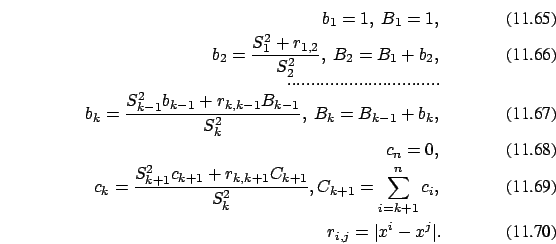
 can be considered as a smoothing parameter.
If  then no smoothing occurs. The smoothing function (the
conditional expectation) is the piece-wise line connecting the
observed points (see Figure 1.1).
then no smoothing occurs. The smoothing function (the
conditional expectation) is the piece-wise line connecting the
observed points (see Figure 1.1).
If is large then one obtains a horizontal line
corresponding to the average value of observed values . That
means a sort of "total smoothing." In modeling the yield of
differential amplifiers, the best smoothing was achieved at
 [Mockus et al., 1997].
Figure 11.1 shows how the first server profit  depends on the price
  charged for its resources. There are
two samples of the same relation. They show the differences
between two samples of random arrival times of fifty customers.
charged for its resources. There are
two samples of the same relation. They show the differences
between two samples of random arrival times of fifty customers.
 |
of the Wiener filter (see
expression (11.71).
Figures 11.2 show the third sample of the 'refreshed' unsmoothed graph and the same sample smoothed by the convolution filter.
 |
The underlying profit function is the same in all the Figures, from 11.1 up to 11.2. The repeated simulation defines different graphs because of the simulation errors. After smoothing, the level of these errors is lower.
Figure
11.3 shows the input page.
The
method 'Bayes1' is set. The parameters:
the number of initial iterations is
5,
is
5,
the number of iterations is 10,
the stocks of server
resources  and
and  is 0.7
the "run-away" threshold  is 20
is 20
the customer rate
 is 20,
the number of time units  is 5
is 5
the efficiency
of all servers  is 1.0
the accuracy is 20 %
the lower bounds  are
0.0,
are
0.0,
the upper limits  are 30.0,
t
Figure 11.4 shows the results of optimization.
In
this figure:
 denotes the "best' iteration
 means the
minimal deviation from the equilibrium point,
means the
minimal deviation from the equilibrium point,
 are the optimal
values of the parameters.
are the optimal
values of the parameters.
Figure 11.5 shows how the profits of the first
server depends on the service charge  .
.
.
 .
jonas mockus
2004-03-20
.
jonas mockus
2004-03-20


