The ARMA models considered in chapter 1.10) reflect non-stationarity by eliminating
unstable parameters using the structural stabilization techniques.
This way some data and some model parameters  are eliminated. The remaining ones are estimated. We consider ARMA parameters as some scales reflecting the influence of the corresponding data sets.
This is done by minimization of prediction errors. No expert knowledge is involved.
Let us consider such models where the expert opinion is involved by choosing such data sets and such scales which reflect the expert opinion about the process.
are eliminated. The remaining ones are estimated. We consider ARMA parameters as some scales reflecting the influence of the corresponding data sets.
This is done by minimization of prediction errors. No expert knowledge is involved.
Let us consider such models where the expert opinion is involved by choosing such data sets and such scales which reflect the expert opinion about the process.
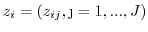
Two expert models are considered. In the first model it is supposed that the prediction  is a product of the present
call rate
is a product of the present
call rate 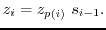 and some scale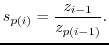
is a predicted call rate, called a "prediction". is an observed call rate, called a "data set". The index  defines the data set used for prediction .
The parameter is called a "scale" for prediction using the data set . Expression (2.52) is a time scale model.
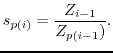
In this model the scale is estimated as
defines the data set used for prediction .
The parameter is called a "scale" for prediction using the data set . Expression (2.52) is a time scale model.
In this model the scale is estimated as
 defines a period preceding
  . The subscript
 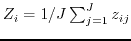 denotes a period preceding .
The term "preceding" means the nearest previous period of the same type. Examples of types: Saturdays, Sundays, holidays,
Christmas weeks, sporting events, days of marketing messages e.t.c.
denotes a period preceding .
The term "preceding" means the nearest previous period of the same type. Examples of types: Saturdays, Sundays, holidays,
Christmas weeks, sporting events, days of marketing messages e.t.c.
In the second model
These expressions differ in the vector case when call rate graphs are predicted.
These graphs are represented as vectors
 . The components
  denote call rates of different parts
  of periods For example, hours if
we predict next day call rates.
of periods For example, hours if
we predict next day call rates.
In the case of vector prediction the first model (2.52)
assumes that the next day graph
is equal to the present one
 multiplied by scales
 denotes the average call rates of the period .
Expression (2.56) means that the shape of of the next day graph is the same as the present one. Only scales differ.
denotes the average call rates of the period .
Expression (2.56) means that the shape of of the next day graph is the same as the present one. Only scales differ.
The second model (2.54)
is based on the assumption that the next day graph is the same as that of the preceding period
 multiplied by scales
We call the first model as the event scale model and the second one as the time scale model. The reason is that the numerator 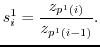 of scales of the first model depends on the type of the next period
because the preceding period depends on the type of the next one.
The period type is defined by the Special Event (SE) which is active in the period. Examples of SE are Saturdays, Sundays, holidays,
Christmas weeks, sporting events, days of marketing messages e.t.c.
The numerator
of scales of the first model depends on the type of the next period
because the preceding period depends on the type of the next one.
The period type is defined by the Special Event (SE) which is active in the period. Examples of SE are Saturdays, Sundays, holidays,
Christmas weeks, sporting events, days of marketing messages e.t.c.
The numerator  of scales
  of the second model depends on the average call rate at the present time .
It follows, that using the event scale model, the next day event SE defines the next day scale. The shape of the next day graph remains the same as today. Therefore, this model reflects the changes of the graph shapes without delay. Using the time scale model, the shape of the next day graph is supposed to be the same as the shape of the preceding one. This way we represent the changes of graph shapes in time with some delay. The delay depends on the interval between the next period and the nearest previous period of the same type. First we consider the event scales model, later the time scales.