


Next: Statistical Approximation: Monte Carlo
Up: Common Waiting
Previous: Common Waiting
Analytical Approximation: Reservation Model
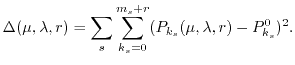
We estimate
 by minimizing the square deviations
 between the stationary probabilities
that there are
between the stationary probabilities
that there are  calls in the
 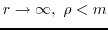 -th server
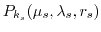 defined by expressions similar to (2.3) assuming that there are
  waiting places reserved for
the calls
waiting places reserved for
the calls 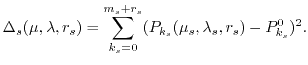 Here
Here
 is the reservation vector and
 .
.
and their estimates 
 |
|
|
(96) |
The estimates are obtained by counting the numbers
of waiting -calls at different time moments. More moments we consider
the better estimation will be. Using the average numbers of waiting calls
in a time interval instead of moment numbers some additional errors are expected that are increasing
with the length of the time interval.
The least square estimation of the call-vector  is as follows
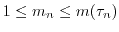 |
|
|
(97) |
The reservation model is simple and clear. However one must test
this model to define when the reservation assumption is reasonable one.
A way to do this is by using a Monte Carlo model.
Next: Statistical Approximation: Monte Carlo
Up: Common Waiting
Previous: Common Waiting
mockus
2008-06-21


