next up previous
Next: Asymptotic Expressions Up: Call Center Model. Previous: Assumptions, Notations, and Objectives

Calculation of Stationary Probabilities

Under these assumptions (see [19]) the probability of $k$ calls in the system, including both, waiting calls and calls in services

$\displaystyle P_{k}(\mu,\lambda)$ $\textstyle =$ $\displaystyle \cases{\frac{\rho^k}{k!} P_0(\mu,\lambda),$ (63)

where $\rho=\lambda/\mu$.

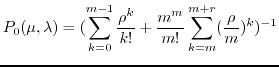
The no-calls probability

$\displaystyle P_0(\mu,\lambda)=(\sum_{k=0}^{m-1} \frac {\rho^k}{ k!} +\frac {m^m}{m!}\sum_{k=m}^{m+r} (\frac{\rho}{m})^k)^{-1}$     (64)

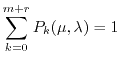
follows from the condition
$\displaystyle \sum_{k=0}^{m+r} P_k(\mu,\lambda)=1$     (65)

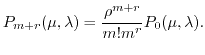
The probability of losing a call at given numbers $m,r,\mu,\lambda$ is
$\displaystyle P_{m+r}(\mu,\lambda)=
\frac {\rho^{m+r}}{ m! m^r} P_0(\mu,\lambda).$     (66)

The average waiting time
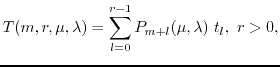
$\displaystyle T(m,r,\mu,\lambda)=
\sum_{l=0}^{r-1} P_{m+l}(\mu,\lambda)\ t_l,\ r >0,$     (67)

where $P_k(\mu,\lambda)$ is defined by expression (2.3) and $t_l=\frac {l+1}{m \mu}$. The waiting time distribution functions
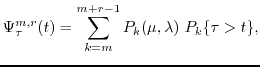
$\displaystyle F_{\tau}^{m,r}(t)= P^{m,r}(\mu,\lambda)\{\tau<t\}=1-\Psi_{\tau}^{m,r}(t),$      
$\displaystyle \Psi_{\tau}^{m,r}(t)= \sum_{k=m}^{m+r-1} P_{k}(\mu,\lambda)\ P_k\{\tau >t\},$     (68)

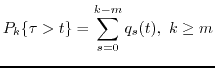
Here $P_k\{\tau >t\}$ denotes the probability that waiting time $\tau$ will exceed some fixed $t$ under condition that there are $k$ calls
$\displaystyle P_k\{\tau >t\}= \sum_{s=0}^{k-m} q_s(t),\ k \ge m$     (69)

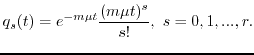
where $q_s(t)$ is the probability that $s$ calls will be served during the time $t$
$\displaystyle q_s(t)=e^{-m \mu t} \frac {(m \mu t)^s}{s!},\ s=0,1,...,r.$     (70)


next up previous
Next: Asymptotic Expressions Up: Call Center Model. Previous: Assumptions, Notations, and Objectives
mockus 2008-06-21