Next: Optimization of Number of
Up: Call Center Model.
Previous: "Surrogate" Services
Call Rate Estimation
It is difficult to estimate the call rate  directly if
  is limited,
because the lost calls are not registered as usual.
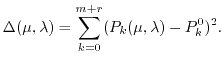
In such cases the indirect estimate can be used by minimizing the square deviations
is limited,
because the lost calls are not registered as usual.
In such cases the indirect estimate can be used by minimizing the square deviations
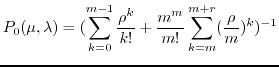
 between the stationary probabilities
that there are
between the stationary probabilities
that there are  calls in the system
 defined by expression (2.3)
and their estimates 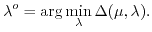
 |
|
|
(76) |
The estimates are obtained by counting the numbers
of waiting calls at different time moments. More moments we consider
the better estimation will be. Using the average numbers of waiting calls
in a time interval instead of moment numbers some additional errors are expected that are increasing
with the length of the time interval.
The least square estimation of the call rate is as follows
 |
|
|
(77) |
Next: Optimization of Number of
Up: Call Center Model.
Previous: "Surrogate" Services
mockus
2008-06-21