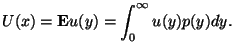
The portfolio problem is to maximize the average
utility of a wealth. That is obtained by optimal distribution of
available capital between different objects with uncertain
parameters [3]. Denote by  the part of the capital
invested into an object
the part of the capital
invested into an object  . The returned wealth
is
. The returned wealth
is  . Here
 and
and
 is an interest rate. Denote by
  the
reliability of investment. Here
the
reliability of investment. Here  is the insolvency probability.
 is the utility the wealth
  . Denote by
  the expected
utility function. depends on the capital distribution
the expected
utility function. depends on the capital distribution
 . If is continuous,
the expected utility function
. If is continuous,
the expected utility function
 is probability density of wealth . If the wealth is discrete
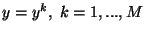 , the expected utility function
 is the number of discrete values of wealth
  .
.  is the probability that the wealth will be returned, if the capital
distribution is
is the probability that the wealth will be returned, if the capital
distribution is  . We search for such capital distribution
which provides the greatest expected utility of the returned
wealth:
. We search for such capital distribution
which provides the greatest expected utility of the returned
wealth: