


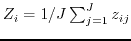
Suppose that the impact of the SE "marketing messages send" will start at the next hour  , which is the second hour of a working day. Asume that the present hour
  is the first hour of a working day with no additional special events. Then the scale
 is the subscript of the most recent previous
second hour of a working day with the same impact SE.
is the subscript of the most recent previous
second hour of a working day with the same impact SE.
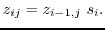
 is the subscript of the most recent previous
first hour of a working day with no SE.
In this example we regarded a multiple SE as two single SE,
the first working hour
without marketing and the second working hour with marketing.
is the subscript of the most recent previous
first hour of a working day with no SE.
In this example we regarded a multiple SE as two single SE,
the first working hour
without marketing and the second working hour with marketing.
Another way is to regard the impacts of those two SE separately defining the scale 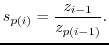 as a product of two scales
 is the index of the first hour and
 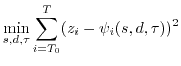 is the index of the second hour of the previous working day,
 is the index of the most recent hour with "marketing" and the most recent hour with no "marketing".
The expression (2.61) needs less data but is based on the assumption that scales are multiplicative, what is not true strictly speaking. The expression (2.60) is an example of empirical approach when multiple SE are regarded as different special events. The expression (2.61) involves expert opinion by assuming the multiplicativity of scales.


